
Readers' Forum
“Of fear and fortitude”
The cover story "Of fear and fortitude” (Parsiana, December 21, 2007) carried good information about Karachi, Pakistan’s prime metropolis, its Parsi population and institutions. The article brought back memories of my visit, about 75 years ago, to the then capital of Sindh which was still a part of India. After I appeared for the final examination in my first year of college I had gone there for my long vacation. My masi and masa (maternal aunt and uncle) Phiroza and Dhunjisha Jagus ("Jagos” as used in Gujarati) were old residents of Karachi. My uncle was a good cricketer who had his own cricket team which provided encouragement to young talent to become proficient in the game.
Seeing photographs of the Jehangir Kothari Parade and Promenade took me back to a moonlight party arranged by Dhunjisha masa at the Kothari Promenade to introduce me, a young collegian from Surat aged 20 years, to his friends, some of whom were prominent persons of the place, including Sir Katrak.
Though the article gave ample coverage to the Parsis of Karachi, I was astonished to find no reference to Jamshed Mehta, the saint of Sindh and to the religious scholar Dastur Maneckji Dhalla. A social worker, Mehta was the acknowledged maker of modern Karachi about whom Mahatma Gandhi had said that if there were a few more Jamsheds in the country, society would have been so different. Dhalla, born in Surat, a city having no inclination toward reforms in matters religious and social, commanded so much respect because of his scholarship, character and superb eloquence.
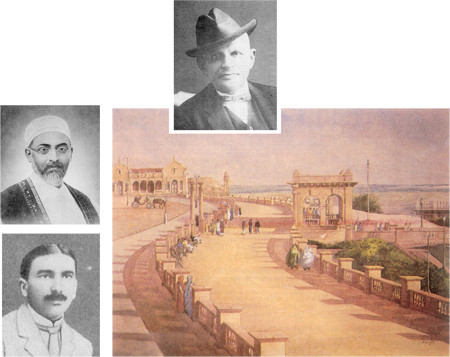
Karachi’s Kothari Parade; inset Jehangir Kothari; (left, top) Dastur Maneckji Dhalla; (bottom) Jamshed Mehta
Photos courtesy The Karachi Zoroastrian Calendar
Rustom Kharshedji Sidhwa was then a prominent political figure in Karachi, participating actively in the freedom movement. Nariman Golwala was one of the very few Parsis contributing articles in chaste Gujarati and Phirozsha Rustomji Mehta, a close relative of Jamshed Mehta, gave to Gujarati literature unique publications on epigrams (chabrakia) and the art of acting, the first of their kind in Gujarati.
A Gujarati newspaper, Parsi Sansar, had been started in 1909 as a monthly and Phirozsha Mehta was its first editor. After some time the monthly became a fortnightly, and later, in 1917 it became a weekly with ownership passing into the hands of Jehangir and Homi Panthaky and, Phirozsha Hormazji Dastoor Meherjirana as its editor. It was given the name Parsi Sansar ané Lok Sevak and published twice a week on Wednesdays and Saturdays. In November 1942 the Gujaratis of Sindh acknowledged the 25-year contribution of Meherjirana to Gujarati journalism and his services to Gujarati society in Sindh.
Your article revived memories of my stay at Kaity Lodge, the fine residence of the Jagus family located practically at the entrance of Clifton (very close to Mota Palace), three quarters of a century ago.
Dr RATAN R. MARSHALL
Ahmedabad
◆ ◆ ◆
From the archive