
Events & Personalities
Pre-paid taxi pioneer
Over 25 years ago, on September 18, 1982, when the first pre-paid taxi was flagged off from Bombay’s Sahar International Airport by Julio Ribeiro, then Commissioner of Police, Greater Bombay, it marked the culmination of an innovative scheme conceived by Dr P. S. Pasricha, then Deputy Commissioner of Police and implemented by his able Assistant Commissioners of Police Sam Darabshah Patel and L. R. Rao, as per a write-up sent to Parsiana by Patel.
Patel, now retired, recalls that it was extremely difficult for him to simultaneously control rowdy taxi drivers who were operating at the Santa Cruz Domestic Airport and Sahar International Airport. Whenever he was at one airport mischievous elements would stir up trouble at the other one. Without the help of his colleague Rao, it would have been an impossible task to maintain some measure of discipline. It was their combined effort which enabled Pasricha to successfully establish and implement the pre-paid airport taxi service scheme, a convenience which travelers today take for granted. "We booked several taxi drivers involved in money lending rackets, including foreign exchange,” Patel informed Parsiana, adding, "We had arrested infamous criminal Billa’s brother, a taxi driver also involved in foreign exchange racket at Sahar Airport.”
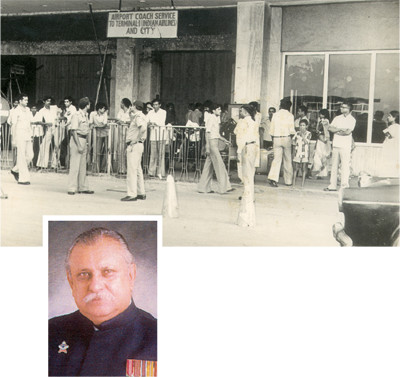
Sam Patel (left) and policemen enforcing discipline at Bombay airport
Earlier, taxi drivers would stop their vehicles alleging a "breakdown” on the way, and coerce passengers into parting with huge sums of money to complete the journey. Foreigners as well as Indians returning from abroad would cough up, fearing for their safety and loss of their precious belongings. "Traveling by air had become a terror for regulars who preferred private transport to using taxis,” Patel recalls. With the situation getting out of hand, Patel and Rao were given a free hand to tackle the situation.
"We worked out six separate zones in both directions from the airport, and the fares for each zone ranged from a minimum of Rs 25 to a maximum of Rs 75 after consulting with representatives of all unions. Even the fare for luggage was fixed at Rs 3 per baggage, handbags and briefcases exempted,” Patel informed the "Westside Plus” supplement of Bombay Times dated September 24, 2007. Different colored receipts were prepared according to the amount payable. A manager and 13 clerks were recruited to look after the booth. The passenger would give his receipt to the driver of the first taxi in the queue and the driver, in turn, would encash the receipt from another counter, eliminating any monetary transaction between the driver and the passenger. Details like the taxi driver’s licence number, taxi number and destination were taken down on a prescribed form.
This scheme resulted in a backlash from disgruntled taxi drivers who, no longer able to fleece passengers, filed a case in the Bombay High Court against Pasricha, Patel and Rao, stating that the pre-paid taxi system had been established arbitrarily. However, their appeal was dismissed by Justice Sujata Manohar who upheld the scheme which had been worked out within the ambit of the law.
◆ ◆ ◆
From the archive