
Events & Personalities
The exclusive nature
The traditions, customs and beliefs of the Zoroastrian community evoke varied responses from non-Parsis, especially foreigners. In her book Holy Cow — an Indian Adventure, Australian radio journalist Sarah MacDonald writes of her visit to Bombay in a chapter titled "Birds of a Feather Become Extinct Together.” The extract from the book published by Bantam in 2004 was given to Parsiana by reader Darayas Jehangir.
Relating about her interactions with Parsis in Udvada, MacDonald writes: "They’re a bossy bunch of cuckoos living in this Indian nest and they’re super keen to keep others out of their territory. When we stop at the outside wall of the temple and unload the camera, at least five approach to tell us we can’t come in.
"We’ve already got the message. A small door and large sign blocks the temple entrance: ‘No intruders, no filming, no photos, no non-Parsi’…
"I’ve never seen a sign like it in India. This is an open door country and I’ve been welcomed into homes, temples, shops, offices and pretty much anywhere I’ve wanted to go. A year ago, such a sign wouldn’t have bothered me at all – of course the sacred spots of different faiths should be respected – but I feel a little put out now. I miss the inclusive, casual nature of Hinduism…
"Thankfully we are invited to lunch...
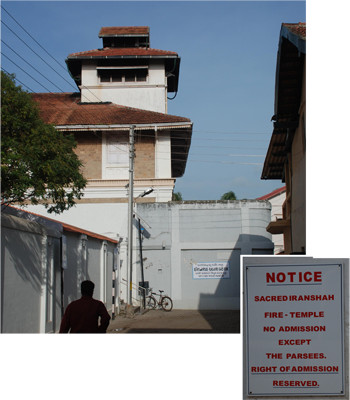
Iranshah Atash Behram in Udvada and the signboard categorically denying admission to non-Parsis
"I order vegetarian – the teachings of Hinduism and Buddhism have spoiled the pleasure of the taste of meat and a sense of sin rises from the thought of eating the flesh of a living being killed for my needs. It seems shocking even to watch meat-eaters. As I sit sucking lentils, a group of middle-aged women take me under their wing and cluck in concern over my limpness in the heat… There’s little small talk between the ladies and me. The caring stickybeaks all seem to be obsessed with my menstrual cycle. My neighbor Mehru openly inquires, ‘You don’t have your period, do you, dear?’
"When I say no, she tells the woman next to her and the information is relayed down the long table with relief. Mehru pats my hand and explains.
"‘We are very strict peoples, dear, once we couldn’t cook for five days when we had them, we couldn’t touch certain cupboards, we couldn’t touch the prophet, now we cook, but you can’t be here with your period, dear.’
"I feel like I’m in a Woody Allen movie, but it’s not funny. I hate crap about women being dirty and long ago tired of the way it taints nearly every religion. Kursheed shows me a Parsi pamphlet from the temple that makes me feel so much better. It explains that women emit ‘poisonous dioxins in their impure menstrual blood,’ and when women bleed they become depressed and their aura becomes ‘dense, dark and morbid.’ What’s more, their ‘emanations are poisonous and can kill delicate plants, spoil foodstuff and the very air around her. Even her breath smells foul.’
"‘We Parsis are very scientific, dear,’ explains Mehru as she reads over my shoulder.”
◆ ◆ ◆
From the archive