
Events & Personalities
Lifetime achievement
At a special function arranged at Baroda’s Prof C. C. Mehta Hall on September 5, 2007, Arnawaz Havewala received the Lifetime Achievement Award for school principals from the Nalanda Knowledge Foundation. Her husband Jimmy, who was presented a shawl for providing inspiration to her, wrote to Parsiana that the award is given after the selection committee painstakingly visits each school, interviews its principal, judges the projects prepared by students and their proficiency before reaching a decision.
The citation presented to Havewala read: "For her teaching is not just a profession, but more a passion; and this sentiment is evident by her commitment and consistent efforts in the field of education… In the roles of both principal and educator, she endeavors to nurture a generation of children that will initiate innovation and research. She involves herself in painstaking efforts… and encourages independent thought in them.”
During her distinguished career spanning over four decades, Havewala has been a motivating force for teachers and students alike, the write-up states. Founder principal of the Prince Ashokraje Gaekwad School in Baroda, she has trained a growing team of teachers to work with consistency and efficiency. Speaking of the role of teacher in real education, Avi Sabavala, chairperson of the selection panel, described how the panel selected teachers for the award.
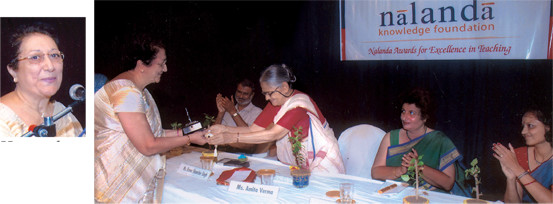
Havewala: committed principal
Havewala will be remembered for encouraging Hindu girls to tie rakhis to Muslim boys who then pledged to protect their ‘sisters’ during the riots during the painful communal disturbances in Baroda. This noble act earned for her the Sanskar Sinchen Award at the hands of the then Gujarat minister for industries and power at a special function.
The write-up reveals that her school, Shree Sayaji Girls High School, the oldest girls’ school in Baroda, adopted a village, Soma Talav, on the outskirts of the city. The girls, under Havewala’s stewardship, conducted an economic survey in the village and helped its residents in getting ration cards. They were also instrumental in getting drinking water, toilets, a primary school, a mandir and a recreation room with a television set for the village. Each time the village was flooded during the monsoon, the school girls had the water pumped out by the Baroda Fire Brigade. Appreciative of these efforts, the minister for industries and power provided electricity to the village.
Havewala is known to have collected clothes and text books for the poor students. She ran the school in two shifts to accommodate many girls from disadvantaged localities as well, the write-up concludes.
◆ ◆ ◆
From the archive