
Sports
The sinew of ninjutsu
Sensei Cyrus Rustomji has been practising and teaching specialized survival skills for over 35 years
Dedicated to the martial art of ninjutsu is Sensei Cyrus Rustomji of Bombay. The burly yet soft-spoken Rustomji holds the rank of Roku dan (6th degree black belt) in the martial skill of Nindo Ryu Ninpo from the World Nindo Ryu Federation. "Most people know about karate, judo, taekwondo, but few are aware of ninjutsu,” asserts Rustomji who has been learning, teaching and practising different martial art forms for 35 years.
Ninjutsu is basically an art for survival and can be learnt by anyone from teenagers to senior citizens, he says. "The word ninjutsu has several meanings. It is the art of stealth, espionage, invisibility, protection against danger. It is the art of the shadow warrior. Its legendary warriors were known as ninjas (‘nin’ meaning patience, endurance, perseverance and ‘ja’ meaning man) who would accomplish their mission by stealing into heavily guarded fortresses and vanish undetected,” Rustomji narrates. Ninjutsu encompasses a variety of specialized fighting skills using armed and unarmed techniques of combat and various weapons and tools of warfare.
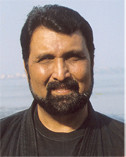
Cyrus Rustomji: into bodyguard services
But ninjutsu is not merely a science of killing, Rustomji explains. "It is an art deeply rooted and set in philosophy. It has a profound understanding of Zen, Taoism, Shintoism, Buddhism; it combines martial arts (bumon) with religion (shumon). The ninja not only deals with the protection of the physical body, but also his mind and spirit,” he asserts.
Rustomji also has a 4th degree black belt (Yon-Dan) in ketsugo (a combination of karate, savate, judo and aikido). He has various qualifications in other disciplines like modern Arnis stick fighting and has trained in the Indian martial art of kalaripayattu in Kerala, states his lengthy bio data.
Rustomji is founder/director of his Combative School of Martial Arts (which he opened in 1990), running classes at Khar and Mahim. He also provides security and bodyguard training and services. He conducts several short courses — urban street survival, self-defense for women and children, executive protection, senior citizens survival training, adventure and warrior training. Rustomji also runs a shop called Ninja Outdoor Survival at Mori Road, Mahim, which sells martial arts equipment such as belts, weapons, uniforms, protective gear, souvenirs, martial art books and magazines, adventure and camping goods, etc. Helping him run the shop is his wife Jasmine who was earlier with a multinational pharmaceutical company.
Though he had a passion for martial arts from childhood, he was a sickly child until the age of seven, Rustomji recounts. In a nine-page interview to the magazine Complete Martial Art (September-October 2004), he spoke of his life and interests: "At the age of 11, my grandmother gave me an old book (on Parsi physical culture) authored by Tehmurasp Sarkari (which) inspired me to improve my physique. At age 12 I joined the local gym…I was taught basic Western boxing in school which gave me confidence to face the bullies.” In the early ’60s, martial arts were gaining in popularity and on his way home from tuitions he would stand and watch the judo and jujitsu techniques being imparted to students at the Bharda High School grounds, as he could not enrol himself due to financial difficulties. "On Saturday and Sunday evenings I used to go and watch South Indians practising and wielding their lathis (long staff) and urmi (flexible Indian sword) at the Gowalia Tank maidan and Parsee Gymkhana. Soon I started getting together a few enthusiastic street friends from the local neighborhood and began training, combining Indian wrestling with jujitsu techniques. We trained in street kumite (fighting) at Victoria Gardens in Byculla or at Chowpatty with the help of a book I had obtained. I continued weight training and did cycling for stamina and endurance.”
In 1970, Rustomji joined the merchant navy as a cadet and sailed for the UK. "There I saw the first martial art movie Big Boss and made Bruce Lee my idol.” While sailing to Calcutta, he met second officer Darayus Marker, a black belt in kyokinshin karate who taught Rustomji basic katas and self-defense. "In my spare time, I continued practising on ship, punched bags and conditioned hands…My first weapon, nanchaku, was made by a fitter for me on board ship.”
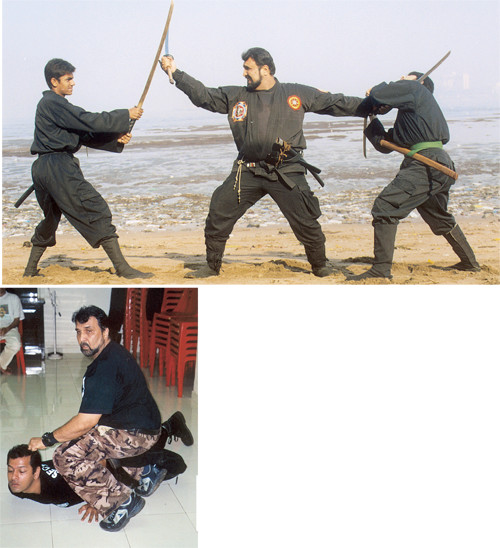
Cyrus Rustomji (top) with students in armed combat and (bottom) self-defense
Back in Bombay, friend Kersi Hathiram introduced him to Sensei Lenny Godinho, a 6th degree black belt in ketsugo at the YMCA (Lamington Road branch). "After that I devoted myself for nearly 25 years (though not continuously) in learning, teaching and practising ketsugo at YMCA International (Bombay Central) and became his (Godinho’s) highest ranked student (4th degree black belt) in armed and unarmed combat in ketsugo. I was their tutor, examiner and also became their zonal secretary… Initially, Sensei Lenny and I were the pioneers for imparting training to various schools. We also imparted ketsugo training to Bombay Municipal Corporation forces at Victoria Gardens and railway protection forces. We often offered security and protection to charitable institutions and organizations,” Rustomji told Complete Martial Art.
While sailing the seven seas, Rustomji had honed his skills over the years by training with masters at various ports of call — Burma, Singapore, Philippines, China… In Calcutta, he trained under Shihan Dadi Balsara, reportedly a 5th dan black belt in ashihara karate, states his bio data. In 1988, after seeking out addresses of ninja masters in America, he went to the US, attending the Third World Ninja Summit and training in different parts of the country. "In 1989, after signing off (the ship), I started teaching ninjutsu to a few serious and dedicated students… I never owned a dojo (school), so I trained my few students on my terrace, gardens, wherever it was feasible. I often trained them at Gorai or Vasai beaches or in Tunganeshwar or Pen mountains. I never advertised…In 1993, I started on my journey to Japan (to train at different centers)…I got promoted to Dojo Cho and was made the sole representative to train and was given an affiliation to teach genbukan ninjutsu in India under a license,” Rustomji told the martial art magazine.
Ninjutsu offers a complete self-protection program. "My main aim is to teach in minimum time, maximum output, maximum speed and efficiency. The techniques have simple maneuvers that can be used in any emergency. No special skills are required, just everyday practise to execute the movements and reinforce mental and physical ability,” notes Rustomji who trains guards for societies, clubs and establishments. His strategic focus, he says, is "to develop, lead and manage a professional bodyguard organization where every member is equipped with the latest world class martial art skills and techniques.”
◆ ◆ ◆
From the archive