
Events & Personalities
Singularly Seervai
Unveiling Hormasji M. Seervai’s portrait at the Supreme Court, then Chief Justice of India R. C. Lahoti remarked, "This portrait installed in the Bar room is in recognition of our respect for the contribution to the stream of justice and the development of law and jurisprudence made by Seervai. We pay tribute to his outstanding characteristics as a jurist, scholar, advocate and social servant. Installing the portrait is one method of keeping alive the spirit of one of the most fearless and dispassionate sentinels of the Constitution as also its principal exponent and interpreter… The presence of Seervai through this portrait in the portals of this august institution, i.e. the Supreme Court of India, would further immortalize the Seervai legacy.”
The function on October 19, 2005 was organized by the Supreme Court Bar Association jointly with the Bar Association of India and the Association of the Advocates on Record, notes a press release. The solicitor general of India G. E. Vahanvati, Fali S. Nariman, president of the Bar Association of India, Ashok Desai and other senior advocates of the Supreme Court paid their tributes too referring to his early years at the Bar, and of the landmark cases in which Seervai appeared both in the Bombay High Court and the Supreme Court.
The book Evoking H. M. Seervai—Jurist and Authority on the Indian Constitution, authored by Feroza Seervai was then launched in Delhi by the Chief Justice.
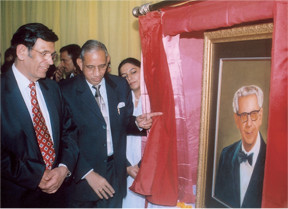
Lahoti unveils Seervai’s portrait as Justice Sa-bharwal looks on
To commemorate Seervai’s birth centenary the Amity Law School, New Delhi named its 2006 inter collegiate national moot court competition in honor of the legal legend. Many judges were present to assess the performance of the participants at the event from March 3-5, 2006.
Pleased that this competition — providing "a marvelous forum to a large number of young aspiring future lawyers to hone their skills and their wits, to make a penetrating study of the meaning of minority rights and educational institutions, and of the jurisprudence bearing on them” — was held in celebration of her husband’s "gifts to Indian jurisprudence,” Feroza Seervai had conveyed in a message: "Seervai was now and again a minority of one: even we, his family, sometimes had thoughts and approaches different from his, and different from each other’s. Importantly we, including children of all ages, had and we exercised our separate rights freely and strongly. Seervai, emphatically in his own life, stood for ‘minority rights’ and for the tolerance of ‘the other view.’ Sadly our countrymen and people all over the world are increasingly intolerant in every sphere of life.”
◆ ◆ ◆
From the archive