
Seminar
“HPY is run by dreamers”
Each edition of the Bombay Parsi Punchayet’s Holiday Programme for Youth features a growing body of innovations
"Diversify, go elsewhere in this country, seek leadership positions in small mofussil towns. Why stick to traditional occupations? Enjoy good food, regional cuisines, enjoy life. This is not a rehearsal. You are not going to have a second chance!” eminent ENT surgeon Dr Ardeshir Khambatta told the 200 bemused school freshers gathered in the heritage hall of the Byramjee Jeejeebhoy Parsee Charitable Institution (BJPCI) at the inaugural of the Bombay Parsi Punchayet’s (BPP) 19th Holiday Programme for Youth (HPY) on April 30, 2005.
Khambatta, who has retired after a long, successful practice at London’s Harley Street, once the Mecca of medicine, was one of four outstanding community achievers who joined the organizers of the HPY to instill in the young participants, on the threshold of their college careers, the concept that the excellence for which the Programme was striving encompassed much more than academic or professional success.
"Excellence is nothing but an improvement of self in all we do in our lives,” asserted award winning gynecologist and obstetrician Dr Nozer Sheriar. "You don’t have to stand first class first. If you help people along and do what is worthwhile for you, you’re a success,” seconded Khambatta. At the valedictory function on May 26, 2005 there was one more man of medicine to endorse the advice. "Exam results are not the criterion. Believe in yourself. Small setbacks can be stepping stones to success,” noted eminent neurologist Dr Jimmy Lalkaka, the evening’s guest of honor. Chief guest and auditor extraordinaire Yezdi Malegam, whose famed integrity has won encomiums from the country’s financial authorities, underscored the virtues of our forebears and advised, "Try to emulate them...arrogance is self-destructive.”
The month-long HPY is the flagship among the BPP’s welfare programs. The brainchild of former BPP trustee and Bombay University vice chancellor Dr Mehroo Bengalee, it was given its initial form and impetus by then BPP CEO and former IAS officer, the late Rustom Anklesaria. The Programme had begun in 1986 with less than 20 participants, as noted Sheroo Master, the recently retired senior executive, who had been associated with it from the start. The 2005 batch numbered 162 participants from Bombay and 38 from other parts of the country together representing 86 different schools, as noted the Programme’s popular chief coordinator and principal of the BJPC Institution Diana Marfatia.
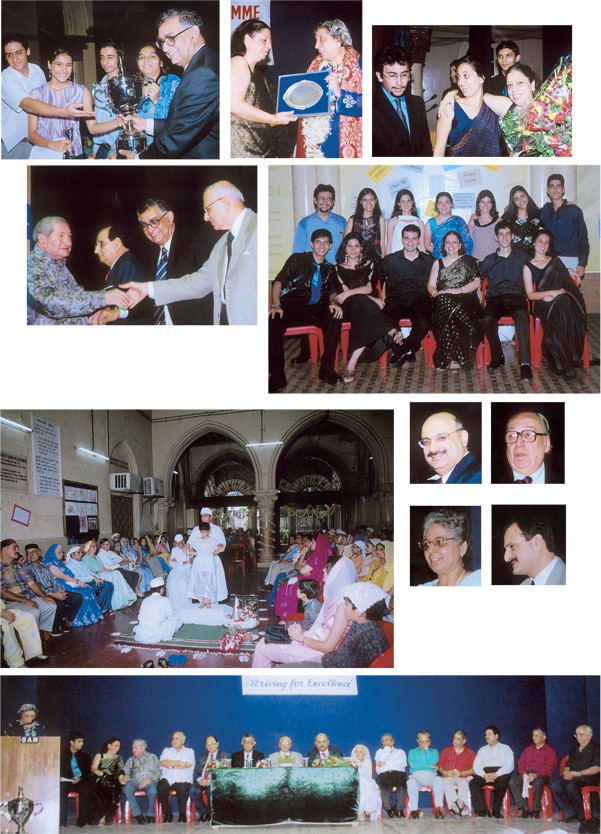
(From left) First row: The four best participants from each group with Malegam; Marfatia presenting scroll to Master; floral tribute to Marfatia from ex-HPYites; Second row: Guzder, Engineer, Malegam and Shroff; the organizing team;Below : Lalkaka (left) and Khambatta; Irani (left) and Sheriar Alongside: Navjote of Jimmy Mehershahi Below: Dignitaries on stage at the valedictory function;
Photos: C. C. Gandevia
The "soul of HPY,” Marfatia — Di as she is known to them — is almost a cult figure with HPYites past and present, having been with it since inception and leading it for the past 17 years. Always ready to share the credit, she told the audience how her growing legion of HPY alumni, currently 3,000 had spawned a crack team of 12 co-workers who begin meeting at her residence every Tuesday evening from 7 to 11.30, starting from the month of August, to plan for the following year’s schedule. Each one of them was duly felicitated at the end of the event.
Held in the heritage precincts of the BJPC which has become the home of HPY for the past 10 years, the course seeks to acquaint those who have just finished school with the wealth of career opportunities awaiting them. Apart from the established professions like medicine, law, engineering and journalism, commerce, industry and the armed forces, there were professionals from the world of the stock market, physical fitness, yoga, the merchant navy, photography and modeling, gemology, event management to speak about these and many more fields of activity.
The development of poise and personality through the understanding of etiquette and body language, of human relationships, environment and self-defense has been consistently and increasingly pursued to help the young to cope in this competitive world. A day at the Godrej factory at Vikhroli helped widen the horizon. A series of aptitude tests aided them to formulate plans for their future careers. And to leaven the high intellectual content there were football and cricket matches, swimming and a fashion show organized by the participants and a hands-on experience in media presentation. They cleaned an agiary, collected 117 bottles of blood, organized a navjote for an underprivileged child, shared lunch and enjoyed an antakshari competition with senior citizens from the Parukh Dharamshalla... And, of course, they imbibed lessons on the Zoroastrian religion and its history. As participant Roxanne Chinoy said to the assembled gathering of educationists, invitees, parents and co-HPYites, both past and present, at the valedictory function, "The visits and activities were eye openers on life. We had bursts of color and creativity at the fashion show. Our tiredness paled under the exhilaration...”
Promising at the inaugural to "give nothing short of the best,” Marfatia, welcomed the assembled resource persons and parents as "our partners in shaping our youth.” Presiding over the event, BPP trustee Dadi Engineer spoke words of encouragement to the 109 boys and 91 girls — most of them experiencing "a tinge of apprehension,” as Chinoy was to note.
Knowing from his experience as an HPY parent "exactly what our young participants work towards and experience during the course of the Programme,” Sheriar spoke of his 13-point ‘joy’ formula for excellence:
The joy of work — "choose a job you love and you will never have to work a day in your life;”
of knowledge — "it’s a treasure that accompanies its owner everywhere;”
of meticulous planning — "failing to plan is planning to fail;”
of discipline — "the bridge between goals and achievements;”
of persistence — a man is "finished when he quits;”
of labor — the prolific inventor Thomas Alva Edison had defined genius as "one percent inspiration, 99 percent perspiration;”
of ethics — apart from the traditional Parsi entrepreneurs, Wipro chief Azim Premji believes "Honesty is good business;”
of leadership — with an open mind, like J.R.D. Tata, you can "command respect but you cannot demand respect;”
of humility — there is no reserved parking place for Premji at his office because he believes if you are important enough in the organization, you should be arriving early and automatically getting a slot to park your car;
of pleasure and laughter — to be effective in life, a sense of humor is essential;
of leisure — hobbies to unwind and recharge one’s batteries;
of dreams and aspirations — unleash your imagination and make magical things happen;
of giving and sharing — Sir Jamsetji Jejeebhoy’s 25 lakh rupees in charity 150 years ago may be comparable to Bill Gates’ $ 27 billion which have saved the lives of more than 76,000 children in our times.
Khambatta, who spends half the year in India studying art and architecture, and is an accomplished pianist and culinary expert according to Engineer, seemed as much awed by Sheriar’s dissertation as the youths: "My little contribution will be quite risible,” he noted in mock horror. Khambatta rued the fact that he had allowed himself to be talked out of accepting his place in the J. J. School of Architecture on the grounds that there was "absolutely no work for an architect in Bombay. The city was stagnant then, but look at it now!” It was a great mistake, a tragedy to be siphoned off into "acceptable professions,” he noted. Confessing to be a computer illiterate who also disliked mobile phones and fax machines, Khambatta was nostalgic of the "lovely art of letter-writing. When you put pen to paper, you put a part of yourself.” Many a time he had "regretted his decision to join medicine,” especially during the initial forays into the dissection hall. "There should be some other way to inculcate the study of anatomy!” he declared. But he said he always enjoyed helping people, especially the underprivileged, in government hospitals. However, "passion and profession melded” when he had a session of throat surgery because he had always been interested in music and singing and the voice. At last, having found his niche, Khambatta went on to peak his chosen field. "If I had had these plethora of activities (planned for the HPY) I might have gone into painting or drama. But there is a degree of creativity in any line of work...The essence of success is individuality.”
According to Lalkaka, the success of the film Munnabhai MBBS was as much that of the four Parsi actors as of star Sanjay Dutt. People like to crack "bawaji jokes, but most of them would love to be Parsis,” he noted. He urged the youths to "believe in yourselves...persevere and not just be cynical...follow the inner voice of conscience and trust in God.”
Malegam related the story of an old man who found a talking frog. Said the frog, "Kiss me and I’ll become a beautiful woman.” Answered the old man, "What shall I do with a beautiful woman? I’d rather have a frog that talks!” Malegam was impressing on the youths the need to appreciate the fact that though the Parsis’ ratio in India is 1:10,000, we are still able to obtain recognition because of the achievements of our forefathers. "Things have changed and it is necessary to recognize the change.”
Noting that there has been tremendous economic development in the past 10 years, that opportunities are increasing and so is the competition, Malegam stated, "India today is no longer considered a poor country, but it has the largest poor population in the world: a fourth of the population lives below the poverty line; one-third is illiterate; 50 percent live in slums...Ours has been a privileged community, living in an oasis.” He urged a revival of the spirit of enterprise, of social responsibility, philanthropy and integrity that once characterized the community. "Most banks had Parsis as chief cashiers. They came from poor or middle-class families...Effort and sacrifice are needed to exploit opportunities,” he added.
One of the highlights of the valedictory function was the felicitation of Sheroo Master who had retired earlier this year as senior executive of the BPP. "There are dreams and there are dreamers. HPY is run by dreamers and one of its original dreamers is Sheroo aunty,” said one-time participant and longstanding HPY organizer Fabian Panthaki. Initially deterred by her "stern and slightly disapproving eye,” Panthaki said he learnt that "it turned out to be an eagle eye for challenges.” Master has been the liaison between the HPY organizers and the BPP trustees and, in Panthaki’s words, "a wall of support,” no matter how outrageous the request. Master was presented with a basket of flowers and a shawl.
Acknowledging the bouquets, both floral and verbal, Master responded with a smile, "I’m not a speaker. I am a puppeteer. I like to pull strings at the back!” Providing the audience with a brief recap of the development of the Programme over the years, the innovations that had made it more productive for the youth, Master attested to the long hours of work, extending to midnight, that the dedicated organizers devote after their own work in the corporate world. To Master it was a matter of pride and exultation that all of them had begun their association with the HPY as participants. "But it would not be possible without the encouragement and vision of the trustees or the dynamism of Di and her team of organizers or the dedication of the BPP staff, especially Bakh-tavar Dastur and Perci Mistry,” she added.
"I am glad that Sheroo’s contribution over all these years has been truly recognized,” noted BPP chairman Minoo Shroff, recalling that he was not a trustee when the HPY began. He observed that with increasing age one learns to value one’s strengths and to enhance and fortify them. He also sought to ingrain the virtue of thrift and savings, the need for a balanced approach ("you win some, you lose some. If winning goes to one’s head, the downward slide begins”), to maintain humility and relish the memory of all good things in life. "Never despair, have faith in your own ideas.”
◆ ◆ ◆
From the archive