
Zoroastrians Abroad
WZO's silver
It was an evening of reminiscence and thanksgiving as over 250 guests — a notable presence of Iranian Zoroastrians among them — gathered together to dine, dance and celebrate the World Zoroastrian Organisation’s (WZO) silver jubilee. A high point of the event in London on March 19, 2005 was the presentation of meticulously crafted scrolls of honor to 30 munificent donors who have sustained the WZO’s socioeconomic, religious and educational activities. "This list is incomplete,” noted WZO chairman Sam Bhiwandiwalla in his welcome address. "There are many more who seek anonymity... The total donations received in India from various sources towards our projects amount to Rs 262,263,540 (£3.28 million, over 26 crore rupees).”
Bright yellow flowers and table settings laid out by Tehmi Patel set the stage for the happy meet which began with a short congregational prayer led by Ervad Rusi Bhedwar, notes the report by Shahin Bekhradnia. Though the Indian high commissioner was too ill to attend the function and was represented by Soumen Ray instead, master of ceremonies and WZO’s joint honorary secretary Darayus Motivala kept the ball rolling.
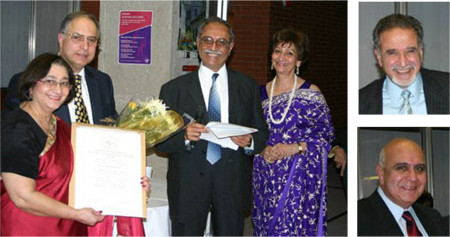
Clockwise from left: Hilda Sethna, Bhiwandiwalla, Captain, Tehmi Patel, Rumi Sethna, Tamboly
As a WZO founder and past chairman Shahpur Captain provided a summary of the contributions of each of the major donors — 10 trusts and 20 individuals — it became apparent that their contributions had not always been public knowledge, writes Bekhradnia. Among the outstanding institutional contributors are the Bai Maneckbai P. B. Jeejeebhoy Deed of Settlement Fund, the Zoroastrian Charity Funds of Hong Kong, Canton and Macau, Sir Dorab and Sir Ratan Tata Trusts, the Bombay Parsi Punchayet Funds and Properties, The Behramji Nowroji Gamadia Parsi Hunnar Shalla Trust, the Mancherji Joshi Memorial Trust, the Settna Memorial Foundation, the Firuz Madon Foundation and FEZANA (Federation of Zoroastrian Associations of North America). The list of outstanding individual benefactors — Zoroastrian and non-Zoroastrian — is headed by Goli and the late Mehraban Farhangi whose initial donation of £ 150,000 "at a crucial time in our community’s history,” as per Bhiwandi-walla, had led to the establishment of the World Zarathushtrian Trust Fund. During Mehraban’s lifetime, the source of the money had been shrouded in anonymity. Others honored in this category were Mehraban and the late Faridoon Zartoshty, Dinshaw D. Mehta, Rena and Behram Baxter, Khorshed and Mahinder Sodhi, Filloo and Eddy Lawyer, Roshan and Noshir Pundole, Jamshed P. Antia, Nanabhoy Bharucha, Zhooben Bhiwandiwala, Zenobia and Kersi Aspar, Sam K. Dastur, Farrokh Vajifdar, the late Dr Shirinbanoo Kutar, the late Mani Bhumgara, Barry Williams, Wilson Daruwalla, Amy Bhabha, Kety F. Mehta and Naju Bhabha. Many, of moderate means, have continued to support the WZO’s work year after year; others have named the Organisation as beneficiary in their wills, noted Sammy Bhiwandiwalla.
Hilda and former chairman Rumi Sethna’s fund-raising dinner-dances and barbeques were fondly recalled as was the yeoman service of the late Noshirwan Cowasjee whose Medical Benevolent Fund aided innumerable Zarathushtis, largely from India, unable to shoulder the burden of expensive medical treatment. And Vajifdar, whose published literary contributions generated funds for the body. An abridged, 15-minute version of Farohar Films’ TV program on the WZO Gujarat Farmers Project masterminded by Dinshaw and Bachi Tamboly, shown that evening, raised over a £ 1,000 more for WZO projects. While those attending the celebration had been requested to make donations when applying for tickets, an anonymous donor had offered to underwrite any shortfall in the costs of the evening, writes Bekhradnia.
"May the Zoroastrian force of good be with you all,” WZO president Rustom Dubash concluded his vote of thanks and the event’s formalities, and the gathering proceeded to a four-course meal and non-stop dancing to the renditions of the four musicians of Black Velvet.
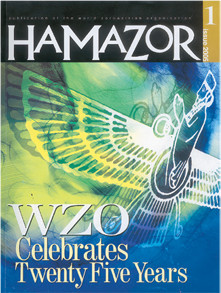
The event has been used to document the history of the WZO in their svelte quarterly publication, Hamazor (issue 1, 2005). The 146-page double issue — there will be no issue 2 this year, as notes its remarkable editor Toxy Cowasjee — includes articles by the men who witnessed the call for a world body of Zoroastrians at the first World Zoroastrian Congress in Tehran in 1960 and pursued the vision to establish the WZO in 1980 in the teeth of community apathy. Thus Dr Farhang Mehr, Shahpur Captain, Adi Davar and historian John Hinnells record their memories/researches, providing a blow-by-blow account of some of the events that shaped the body.
Karachi based Cowasjee invited Captain to be guest editor of the issue which, apart from commemorative articles, has a wealth of scholarly contributions on the religion by the likes of Dr Helmut Humbach, Profs Kaikhosrov Irani and Antonio Panaino, Dr Yasmine Jhabvala, Dina Mcintyre and Vajifdar. Former ambassador and UN representative Jam-sheed Marker and FEZANA founder president Rohinton Rivetna share their illuminating personal perspectives on where the religion of Zarathushtra could lead the community and the world. Over and above these, this collector’s issue incorporates a wealth of other articles by well-known Zoroastrians focusing on aspects of community life as impacted by the religion.
◆ ◆ ◆
From the archive