
Readers' Forum
A navjote for nine
While going through old records, my cousin Gordafrid found two navjote program cards: one for my navjote performed in 1934 along with that of eight other cousins, and the other for her’s performed in 1938 along with the wedding of one cousin and navjote of another.
Apart from the names of the navjotees, these cards give the full menu together with the name of the caterer, the varieties and brands of liquor to be served, also the name of the conductor of the band and the details of the music to be played! These are not the usual menu cards, but are program cards. I do not know whether they were sent out with the invitation cards or were handed out at the baug as the guests arrived.
All nine of us were placed in one row inside the pavilion — the so called otla — and the corresponding number of priests chanted the prayers together and the ceremony was performed simultaneously, not one after the other.
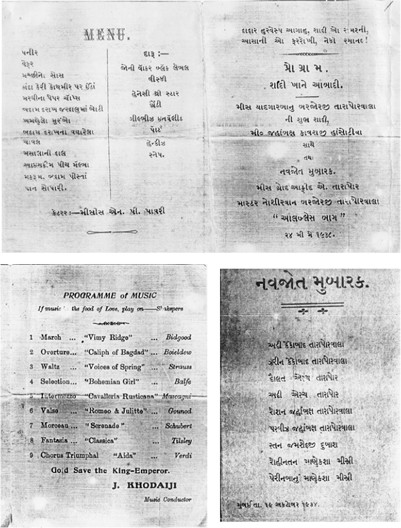
Navjote cards: reason to rejoice
In those days there was no fixed stage and no concrete pavement. The earth was covered up with coarse red carpets stitched together so that the saris and the trousers did not get soiled. Occasionally shamiana-like coverings were provided at places and small colored lamps with round flat shades lit up the entire area. Liquor was served with dinner and wine glasses were placed with every patra. Children would protest when mothers insisted on pouring a few drops of brandy on their ice cream so that they did not catch a cold! For some strange reason, the bearers who served food were invariably Parsis or Lalias, those who served cold drinks and ice were Christians, and liquor of course was served by men from the host family. The bands and shamiana-cum-catering business were virtually monopolized by Khodaiji or Cassinath and Pavri or Bhoot.
RUTON J. DUBASH
◆ ◆ ◆
From the archive