
Readers' Forum
“Volunteer pallbearers”
Roda D. Hakim’s letter "Volunteer pallbearers” (Readers’ Forum, Parsiana, May 2004) raises some interesting points. In principle I am in agreement with its contents, but then your editorial reply also raises certain valid concerns.
The problem as I see it is two-fold. Firstly, the need for social and financial emancipation of the poor khandhias and nassessalars. They should not be seen as second-class Zoroastrians, and if the use of volunteer pallbearers has become the norm, then the standing of the khandhias should improve. Perhaps if the duty is shared by both, the khandhias and the bereaved family’s friends and relatives this would acknowledge "dignity of labor.” It would do the self-esteem of the khandhias no harm at all even if this sharing of the duty were only "symbolic.” The friend/relative could help for only a part of the journey, say up to the doors of the dakhma, and then the khandhias could take over.
Secondly, as the writer points out, the "merit-earning duty” which accrues when a friend or relative of the departed is required to act as pallbearer. Of course, there may be practical difficulties (for example, a large coffin), and other problems quite rightly pointed out by the editor, but I am sure that if the will is there, no problem is insurmountable. I think I am right in thinking that here in the UK, to be asked to be a pallbearer is a privilege, and at celebrity funerals the nearest and dearest of the departed almost always perform this duty as a mark of love and respect.
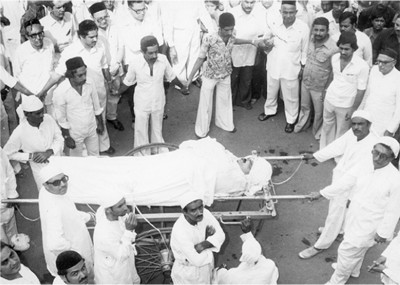
Pallbearers deserve respect
Of course, any changes to the system will take time and I daresay meet with opposition. The main argument would be that Zoroastrianism considers a corpse to be unclean hence work for khandhias only. Of course there may be difficulty in getting volunteers. Perhaps the Bombay Parsi Punchayet can look into this?
A discernable "advantage” that burial and cremation have over our method of disposal is that friends and relatives of the departed can visit the grave or visit the urn containing the ashes and perhaps place flowers and meditate there. I had lost a dear Christian friend a few years ago, and ever so often I visit his grave in a peaceful churchyard, placing flowers whilst fondly reminiscing over the happy times we had shared. Sadly, our system, for all its virtues, cannot lend itself to this act of love and respect for the departed.
ADI SIDHWA
London, UK
The debate on the crematorium versus dakhmenashini issue, strangely enough, immediately produces an involuntary grin on my face. However macabre that may seem, the first thought that comes to mind is a joke which used to circulate widely when we were children. It seems a Hindu accused a Parsi of being jealous of the majority community, using the words, "Tamé baroch (You burn with jealousy).” The Parsi, with his usual inimitable sense of humor, answered, "Aakharé tau tamé baroch, hamé tau baug ma sooee jayéch. (In the end, it is you who burn, we go to sleep in a beautiful garden).”
Jokes aside, I would like the people who advocate the crematorium to look at the issue as a civic responsibility. Does the scientific and educated community, who seem to largely make up this pro-crematorium faction, really believe that matter, when burned, disappears and is no more? Have they considered what happens to each of the body components when they are heated and what chemicals are released into the air for the living beings in the surrounding areas to breathe? What about the components that are happily being inserted into our bodies nowadays? The artificial valves in the heart, the intra ocular lens in the eyes, the various metals, and so on.
Burning fills the surrounding air with particles of our body garbage. It causes air pollution and spreads cancer and asthma — maybe other problems as well.
If the Parsis’ aim in life is to leave the world a better place than the one we are born in, then the crematorium idea defies the very raison d’etre of our existence. We are well known for our acts of generosity in our lifetime and in our death. Let not our last act be that of poisoning our friends and our environment!
And why does Gooloo Mehta ("Volunteer pallbearers,” Readers’ Forum, Parsiana, June 2004) want to "build a small crematorium for those in favor of this system?” Is she not aware that incinerators all over the world are being closed down as no one allows them in their backyard? There are already a number of them in existence and all communities are welcome to use them — so why does she feel the need to specially favor the Kemps Corner and Pedder Road residents with the gifts of ill-health?
And by the way, the system of khandhias exists only in Bombay and maybe in some other big cities. Everywhere else, it is Parsi family and friends who handle their own dead with utmost respect and love. No one segregates those who handle the dead and they already are integral members of the mainstream society.
PERVIN JEHANGIR
You have rightly told Roda Hakim that volunteer pallbearers would have a harrowing experience should they venture inside a dakhma. Worse than the ghastly sight would be the ghoulish smell emanating from the decomposing corpses. The khandhias may pinch their noses and do the work. Why not do away with the khandhia system completely?
Ever since the vultures have disappeared from Doongerwadi, I have taken the stand that dakhmenashini must make way for cremation which is the most sanitary method for the disposal of the dead. The case for an aviary is untenable when the vulture species is dying all over the world. The installation of the solar reflectors at the dakhmas has converted dakhmenashini into a two-stage burial. After dehydrating the body over several days the remains are finally buried in an astodan.
Apart from the five electric crematoria operated by the Bomay Municipal Corporation at Chandanwadi, Haines Road (Worli), Shivaji Park, Sion and Kandivali, the Government of Maharashtra has recently installed a crematorium at Mulund (West), Greater Bombay, operating on natural gas at a price of only Rs 7.50 per standard cubic meter of gas. The time has now come to opt for modern state-of-the-art systems for the disposal of the dead.
Dr P. D. SUNAVALA
◆ ◆ ◆
From the archive