
Books
Vegetarian virtues
Several Parsis abstain from meat-eating during the monthly anrojas and the entire Bahman mah. This sacrifice is in honor of the archangel Bahman who is said to preside over the entire animal kingdom. But even in these relatively short periods of abstenance fish and eggs are consumed. Keeping in mind the community’s almost inherent dependence on a non-vegetarian diet, Ervad Edal Cassad’s abridged edition of An Anthology of Vegetarianism — From Zoroastrian Religious Point of View, is a welcome change. Edited, published and printed by Cassad, the Anthology contains articles by 12 writers propagating a healthier vegetarian way of life.
Largely quoting and reproducing the work of the late scholar Behramshah Pithavala, the arguments in favor of vegetarianism are mainly based on the belief that a carcass whether human or animal is considered a naso (impure) and "un-Zarathushtrian” if consumed. It is a sin, Pithavala elaborated, to touch or eat anything which has become a naso: "to immerse it in water is an offence against Khordad Ameshaspend, to place it on a stove and cook it is an offence against Ardibehesht Ameshaspend. Further to kill an innocent domestic animal is an offence against Behman Ameshaspend.” He emphasized that vegetarianism along with a belief in reincarnation and observance of the Dini Saal calendar, are the "three inviolable tenets on which Zoroastrianism rested.” Warning community members to "abstain rigously” from eating the flesh of all domestic animals, Pithavala asserted that deviating from this tenet would mean facing "a strict reckoning in this world and the next.”
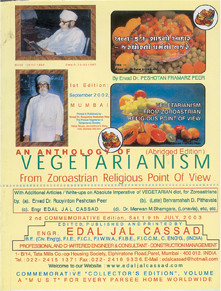
Most of the authors in this Anthology tend to subscribe to the Ilm-e-Kshnoom philosophy. Cassad quotes Behramshah Shroff, who insists that "the lesson of vegetarianism is for all mankind.” Bomi Sachinwalla states in a review of the Anthology, that "The prevailing trend amongst Parsis to justify the intake of ‘flesh’ in the name of religion is most annoying.” He mentions that "the collective thought force of protest and pain emerging from the slaughtered animals is termed as geush-morenedan, which spreads in spiritual realms and disturbs the working of Behman Ameshashpand...”
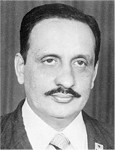
Cassad: propagating vegetarianism
Though these authors maintian that non-vegetarianism is a sin and "unZoroastrian” in practice, others like scholar Dastur (Dr) Firoze Kotwal state that "religious books prohibit eating flesh for three days after someone’s death. But it is not accurate to say that in general eating flesh is improper.” In fact in an essay by Kotwal and Jamsheed Choksy in Micheal Stausberg’s Zoroastrian Rituals in Context, it is stated that the early evening food offering placed before a priest in the stum ritual, includes "thin wheat bread, potatoes with meat, fried fish, cream custard, wine and a pot of well water.”
Irrespective of whether Zoroastrianism propagates a vegetarian lifestyle, Shernaaz Engineer’s argument might be more convincing, "I believe that every creature great and small has the right to life. Unquestionably. Non-negotiably. It is not for us to take a life and then attempt to justify it.”
The Anthology, though a little tedious to read because of differing layout styles, un-numbered pages and varying type sizes, has a tendency to drift from the main subject of vegetarianism. Yet, as points out Sachinwalla, it is proof of Cassad’s bold endeavor to deal with a subject that the majority of the community would rather leave unaddressed.
Priced at Rs 145, An Anthology of Vegetarianism — From Zoroastrian Religious Point of View can be purchased from the author, 1-B/14, Tata Mills Co-operative Housing Society, Elphinstone Road, Parel, Bombay 400012. Tel: 24151371, Fax: 24169336, E-mail: edalcassad@hotmail.com.
Simin J. Patel
◆ ◆ ◆
From the archive