
Readers' Forum
Parsis in Diu
Most of us know that after leaving the shores of Iran more than a thousand years back, our ancestors first landed in Diu and stayed there for about 19 years before embarking again and landing in Sanjan and other towns on the Gujarat coastline. On spending a day in Diu we were pleasantly surprised to know that there still exists a Parsi-wad in Diu, although there is not a single Parsi living in Diu at present. I had heard that the defunct agiary building was in the occupation of Christian nuns. Although difficult to find the same, when we reached the place, St Anne’s Kindergarten School, the nuns very graciously invited us in and showed us the room, with a dome-like structure, with openings (now plugged) in the "dome,” where the atash kebla may have been placed. Some friends who had visited the place earlier tell me that they had even noticed a hook for hanging the bell as also the pavi. The room is now used by the nuns as a chapel. In the compound was a well (a must for an agiary) and nearby my wife noticed a khuvan, the stone pedestal on which the afarganiu is placed.
We were able to see the dakhma, only from a distance, located on a hillock and overlooking the sea. The land surrounding the dakhma was fairly large and had a compound wall which we were told was built by the Archeological Department which looks after the place. Our enquiries revealed that it was a disused Parsi smashan (cemetery) and that quite a few Parsis used to live in Diu in the past and owned considerable property. ‘Divecha’ is not an uncommon surname amongst Parsis, which supports this.
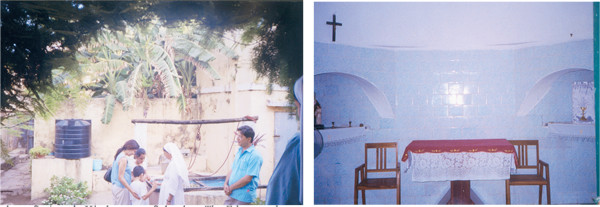
Diu’s erstwhile atash kebla now used as a chapel (right) and the well outside the agiary
Were the agiary and dakhma built by our ancestors when they first landed in Diu over 1,300 years ago or by Parsis who may have come and settled in Diu in later years? The latter appears more plausible. Can someone throw light on this matter?
If not already done, could we not investigate and claim these places as our heritage properties when celebrating the 3,000th anniversary of Zoroastrian culture? I understand that there are other valuable Parsi (anjuman) properties in various towns of Saurashtra and Gujarat which have been encroached upon. Efforts should be made to get the same released and liquidated. Or, are efforts already being made in this direction?
R. S. MEDORA
Ahmedabad
The Editor replies
The status of the agiary and dakhma in Diu have been discussed at several meetings of the Federation of Parsi Zoroastrian Anjumans of India. The defunct anjumans subcommittee of the Federation has, over the years, intervened to salvage community assets where possible.
◆ ◆ ◆
From the archive