
Medicine/Health
The Turners’ touch
Dentistry is a family affair for the Turners with father, mother, daughter and son practising the profession
The 14-year-old girl always used to be an introvert with a sad look on her face. Her father approached the well-known dentist, Dr Porus Turner, who prescribed treatment for her irregular teeth. The father could not afford that. Turner took up her case, nevertheless, treated her mucosa (gums) and then went in for aesthetic dentistry, the art and science of giving people like her a beautiful and healthy smile. He not only changed the girl’s looks, but also her attitude, turning her into a cheerful and confident person.
Turner’s mission is "to help people eliminate their sufferings and make a big difference to their lives.” And his vision is "to be among the best dentists in the world and ensure that my children, my son-in-law and my grandchildren follow the same mission and vision!”
The Turner family is indeed unique. It is a family of dentists with multi-specialties, with clinics in Bombay at the Gamadia Polyclinic, Tardeo, which also boasts of an in-house dental laboratory, and at Rustom Baug. Porus is the first dentist in the Turner family. He is married to Mehroo, a Master of Dental Surgery (MDS), specializing in academics. Their elder daughter Ferzin Vazifdar, also a dentist, specializes in orthodontics and is involved in aesthetic dentistry. Son-in-law, Danesh Vazifdar, though a BA in Economics, has taken his vocation seriously and runs the Turner family’s dental laboratory. Porus’ younger son, Ashdin, didn’t have much choice since "everybody in the family had completed their masters in dental surgery.” Apart from helping his father at the Gamadia Polyclinic, he is associate professor at the College of Dental Sciences and Hospital, Indore. Ashdin’s wife, Khushnaz helps her father in his courier business. Porus’ younger brother, Yazdi, is a practising dentist in Montreal, Canada. Yazdi’s wife, Mahnaz, although not a dentist, helps him in his practice. Their son, Zain is in his final year of dentistry, studying at the Mc Gill University. Porus also has two elder sisters, Aloo and Katy who are not dentists.
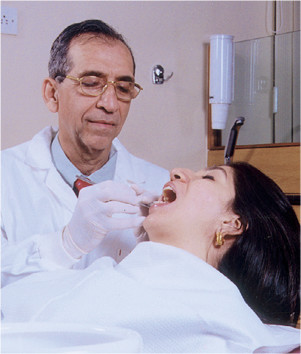
Porus with a patient
With almost the whole family into dentistry, it can be anyone’s guess what the grandchildren would become in future. Says Porus, rather sternly: "We cannot let our children decide their career for themselves. Children are too immature for that.”
Dr Porus Turner’s clinic boasts of state-of-the-art equipment such as Light Curing Unit, Ultrasonic Scaler, X-Ray machine programed with electronic timer, motorized unit for root canal treatment and Intra-Oral Camera for patients to view their teeth before, during and after treatment on a monitor. Besides, all the instruments are placed in separate trays after scrubbing and ultrasonically cleaning them, and are then autoclaved. All other materials such as syringes, needles, glasses, suction tips... are disposable.
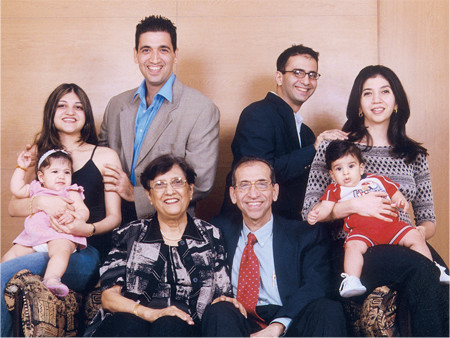
(Above) Mehroo and Porus Turner surrounded by family (from left): Thea, Khushnaz, Ashdin, Danesh, Ferzin and Zane.
Apart from metal-free ceramics (porcelain laminate veneers), which are principally used for smile-designing, the Polyclinic specializes in porcelain fused to metal crowns and bridges (fixed dentures). The Turner family is also into dental implantology, "the science of surgically implanting ‘titanium’ root shaped implants into the bone, which is later attached to artificial teeth to replace the lost teeth.”
Dentistry has advanced tremendously. To keep pace with the advancement is the key to the Turner family’s success. They have to subscribe to the latest dental journals and books, try out different products, understand their drawbacks and advantages, enroll for short courses with leading international authorities on dentistry... But there is one more secret to Porus’ success — showing concern for patients, making them realize that he is there for them at any time, ready to give his best. His charges range from Rs 200 to Rs 6,000 depending on the amount of work to be done. But when it comes to serving poor Parsis, he is flexible about his fees. Besides, he is an expert in helping patients overcome the fear of pain, the fear of cost and the fear of time.
Porus is greatly inspired by Dr Gordon Christensen, founder and director of Practical Clinical Courses (PCC), an international continuing education organization for dental professionals. A researcher, academic and businessman based in Utah, USA, Christensen has presented over 40,000 hours of continuing education throughout the world and has published hundreds of articles and books. His family also has five dentists.
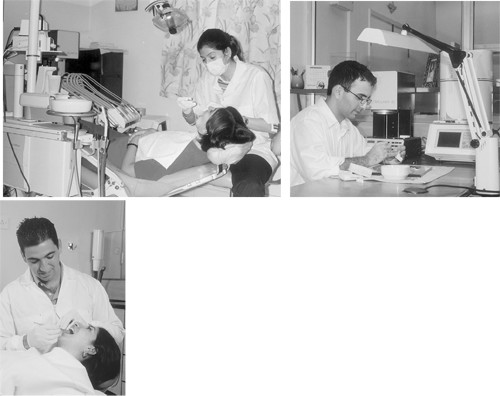
Clockwise from top left: Ferzin treating a patient; Danesh in his dental laboratory and Ashdin examining patient
Born on October 5, 1942 in a middle-class Parsi family to Shirin (née Irani) a housewife, and Shawakshaw Turner, secretary at the Sun Life Insurance Company of Canada (now Life Insurance Corporation of India) Porus was greatly influenced by his uncle, Phiroze (fondly called Pila kaka), who dinned into him at a callow age the importance of a career in medicine. Porus reminisces: "Pila kaka always used to tell me how honorable, noble and lucrative the medical profession was, how much respect it would bring to me and my family...” Porus worked hard to enter the medical profession, but lost by a few marks. The next best thing was to enter the field of dentistry.
In 1964 Porus became a Bachelor of Dental Surgery (BDS) from the University of Bombay and in 1966 he became MDS from the same University. From 1966 to 1968 he worked on an oral cancer research project in India’s remote villages, sponsored by the National Institute of Health (NIH), USA and conducted by the Tata Institute of Fundamental Research. In 1968 he started working as staff dental surgeon at the Bhabha Atomic Research Centre (BARC) Hospital in Bombay. The nature of his work included clinical research, besides attending to the dental needs of BARC employees and their families. The urge of starting his private practice from his house at Rustom Baug was very strong. The dentistry profession had not fully developed and was not even considered lucrative. Porus could hardly afford an expensive dental chair and therefore bought a foot-operated dental chair from Godiwalla and Company. Wife Mehroo would pedal it while Porus would attend to the patient in the drawing room for an hour every evening after returning from BARC.
Porus met Mehroo when they were studying for their MDS. Mehroo worked as professor and head of the Department of Prosthodontics at the Government Dental College and Hospital for 28 years till she opted for voluntary retirement (VRS) in 1982. Till some time ago Mehroo also helped Porus in his practice. Being inclined to academics, she still delivers lectures at the A. B. Shetty Institute of Dental Sciences (a private dental college in Mangalore). Ferzin remarks, jokingly: "Mummy is our manager. She manages our accounts, the stocks we buy, how and where we invest... She is the whole and sole. We call her ‘the queen.’”
As Porus’ practice grew, it was becoming increasingly difficult for him to sustain the BARC job. He opted for voluntary retirement in 1989 at the age of 48. Says Porus, proudly: "After taking VRS, I bought a new American dental unit, inclusive of patient’s and doctor’s chairs, assistant’s stool, etc. Ferzin joined me in 1992. My practice grew further, and it was necessary to buy another dental unit.”
It was time for Ashdin to start his practice. By sheer coincidence, the Parsi Punchayet came up with a proposal of constructing a polyclinic at Gamadia Colony, inviting Zoroastrians to apply for the same. Ashdin applied for the clinic and Ferzin for running a dental lab. Their applications passed, the Turner family set up two dental units in the Clinic along with an in-house laboratory in which Danesh plays a crucial role. Explains Danesh: "In the dental lab we fabricate the actual tooth from the cuttings provided by our clinics. We have four staff members. We’ve taught them everything from the basics. In the lab we take care of metal and porcelain restorations.” Danesh has to understand the tooth thoroughly. He has to match the porcelain and/or metal restoration with the natural tooth in anatomy and in color. Sometimes he has to even mix and match porcelain powders to get the exact color of the tooth. The laboratory is now recommended by outside dentists as well.
Porus is one of the founder members and past president of the Indian Academy of Aesthetic and Cosmetic Dentistry. Presently, he is serving as its honorary general secretary. He is also affiliated to numerous other dental associations and is Fellow of the Academy of Dentistry International. Author of Art and Science of Aesthetic Dentistry he has contributed to two books on dentistry, and several national and international journals. He lectures extensively in India and abroad on restorative dentistry. He also teaches at the A. B. Shetty Institute of Dental Sciences as professor of postgraduate studies in the department of prosthodontics.
The March-April 2003 issue of Bridal Guide carries an article entitled "Kissing Calamity.” It is stated that, according to a study published recently in the Journal of American Dental Association, smooching, sharing the same food, the same cups, utensils and toothbrush cause cavities. Porus dismisses these as there is "no 100 percent documented proof” of a partner passing on caries (cavities) to the other. Apart from checking the patient’s teeth, Porus makes it a point to check the mucosa, the tongue, the cheeks and the jaws as "the Indian population has the unique distinction of having the highest incidence of oral cancer in the world. This happens mostly due to smoking and chewing tobacco. Infected teeth could also, in rare cases, cause oral cancer (see "Turner’s tips,” alongside).”
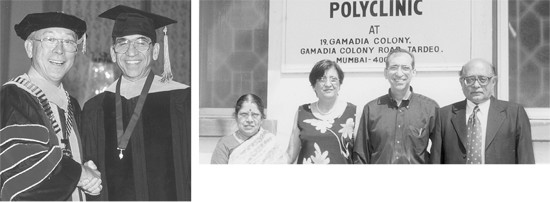
Left: Porus being congratulated by Dr Tanaka on becoming a Fellow of the Academy of Dentistry International. Above: Mehroo and Porus flanked by P. Chidambaram, principal advisor to the Government of India, and his wife at the inauguration of the Tardeo clinic
The Turner family is very religious. Zoroastrianism, according to Porus, is one of the most enlightened religions: "Even before anybody could discover the connection between smoking and ill-health, our religion taught us not to smoke.”
The diminishing Parsi population, especially due to interfaith marriages, worries Porus: "We are barely a population of 70,000. That’s why we cannot afford to be liberal. Our forefathers fled Iran to preserve their identity. If we dilute this by having inter-caste marriages, what’s left? Would anybody even remember that there was a Zoroastrian race once upon a time?” At the same time, he feels that in order to bring about gender equality, "children of Parsi mothers and non-Parsi fathers could be allowed to enter the Parsi fold.” In the same breath he clarifies once again: "But I’d still not like to advocate and encourage inter-caste marriages.”
His views on dakhmenashini: "If vultures are not available, we should find alternate means of disposing the dead without, of course, going against the religion. It is important to maintain our Towers in their pristine form.”
Porus is involved in community welfare activities too. He has been president of the Sir Ness Wadia Club at Rustom Baug for the past decade, and is responsible for organizing several events such as gambhars and May Queen Balls. He also gets funds for other social and sports activities such as the Body Beautiful Contest, annual football tournament, maintaining a gymnasium with state-of-the-art equipment and maintaining the newly converted rough and uneven Rustom Baug grounds into a lush green lawn.
Porus is an active member of the Zoroastrian Dentists Organization (ZDO) which holds camps at all the Parsi colonies as well as at the Doongerwadi to teach oral hygiene, distribute toothbrushes, toothpastes, etc. He is also chairman of the Fifth World Zoroastrian Dental Congress, to be organized under the auspices of the ZDO, at the Oberoi Towers, Bombay from September 19 to 21, 2003. Says Porus: "I’m constantly trying to arrange for special concessions for Zoroastrians at the A. B. Shetty Institute of Dental Sciences. Approximately 10 Zoroastrians have so far benefited and have successfully completed their BDS or MDS.” The Turner family wants more and more Zoroastrians to join the dental profession.
Turner’s tips
The first step towards strong teeth is a healthy diet: "It is a fallacy that biscuits give energy to children. On the contrary, they stick into the pits and fissures of molars and do not wash off easily. Bacteria play upon these, creating acids which dissolve the teeth and form cavities,” explains Dr Porus Turner. It should be noted that in order to have healthy teeth, it is the frequency rather than quantity of sugar intake that causes cavities. Turner has written to the Advertising Council of India to ban advertisements claiming that toothpaste can prevent cavities irrespective of the number of times children consume sweets, biscuits, etc.
Brushing teeth correctly is more important than the frequency of brushing. Porus recommends Colgate Acti-Brush, an electronic toothbrush, which "is programed to brush your teeth properly” or, a manual toothbrush with soft bristles like Colgate Sensitive Toothbrush.
Use a toothpaste containing fluoride, along with antibacterial agent and copolymer to retain both the fluoride as also the antibacterial agent on the teeth.
Cleaning the tongue with the same brush while brushing the teeth is equally important.
Flossing once a day is good. "Learn to floss properly, else you’ll injure your mucosa,” warns Porus.
After eating, make sure to drink a glass of water or swish some water round and swallow it.
◆ ◆ ◆
From the archive