
Events & Personalities
Udvada’s cultural museum
Pilgrims to Udvada would be happy to learn that the Dastur Kayoji Mirza Museum of Udvada and Iranshah was inaugurated on April 28, 2002. Located on the first floor of the Dastur Kayoji Mirza Memorial Hall on the main road of the Udvada village, the cultural museum has become a reality thanks to the initiative of the Youth Wing of the World Zoroastrian Organisation (WZO) and the generosity of Dastur (Dr) Hormazdyar Mirza who has permitted his family premises to be used for this project, notes a write-up by Zelda Mistry.
The jashan was performed by Hormazdyar’s son, Ervad (Dr) Peshotan Mirza together with Ervad Framroze Sidhva, the secretary of the Udvada Anjuman. The jashan elicited a grand turnout of priests and locals of Udvada, donors of the exhibits, WZO Youth Wing and parent body members, and pilgrims from Bombay and other parts of Gujarat. Many of the guests were put up at the comfortable Ervad Ratansha Katila resthouse, writes Mistry. Inaugurated in April 2001, the resthouse is yet another institution managed by the WZO Youth Wing as part of its "Project Udvada.”
Expressing his gratitude to all who gave freely of their time, talent and efforts to help set up the Museum, Youth Wing president Sarosh Bana was particularly appreciative of Hormazdyar Mirza’s dynamism and the wholehearted cooperation of the late Dastur Kaikobad Dastur. The largesse of Zal and Roshan Contractor as also Bachi and Dinshaw Tamboly who had gifted artefacts to the Museum was also commended. Dr Kalpana Desai, the experienced director of Bombay’s Prince of Wales Museum (now rechristened Chhatrapati Shivaji Vastusangrahalaya) has evinced keen interest in developing the Udvada Museum, mentioned Bana.
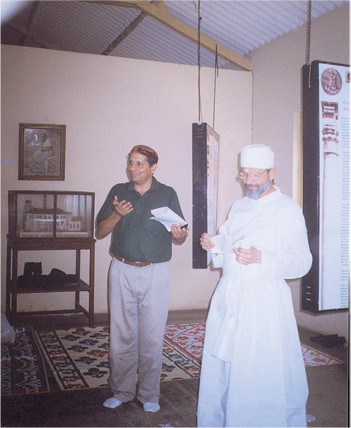
Bana with Peshotan Mirza at Udvada’s new Museum
On behalf of the trustees of the Kayoji Mirza Hall, Peshotan Mirza congratulated Bana and his team and urged those present to pass on the Zoroastrian principles, customs and traditions to the younger generation, reminding them of the tribulations faced by their ancestors to protect the sacred fire.
The Youth Wing has expended Rs 1.8 lakhs on this Museum project, according to Mistry’s report, and would appreciate donations in cash and kind from the community. Among the treasures they are keen to acquire for the Museum are: an antique portrait of Zarathushtra, a chandelier or central lamp, an old clock in working condition, four display cases, and any records of Udvada, the Iranshah or the families living there. Contributions marked to "WZO (India) YouthWing” may be forwarded to Bana at 52, Bakhtawar (Main), 22, Narayan Dabholkar Road, Off Napean Sea Road, Bombay 400006, Tel: 3679717, 3616025, e-mail: sarosh_bana@hotmail.com
Among the exhibits on view at the Museum are religious implements used for liturgical ceremonies, an Iranian carpet, portraits depicting Parsi attire in bygone days and specially prepared panels depicting the history of Iranshah and Udvada. With admission to the Museum free to all, Parsis as also non-Parsis, Bana hoped that it would help to create an awareness of the grand heritage of Udvada. The Museum will be open from 10 a.m. to 1 p.m. and 3-6 p.m. on all weekends, public holidays and the months of Adar and Ardibehesht.
In Bombay, the Youth Wing organized the third series of talks on health issues at the Banaji Atash Behram hall, according to a report forwarded by Mahatab Patel. Dr Aashish Contractor who heads the cardiac rehabilitation department at the Cumballa Hill Hospital and Heart Institute spoke on "Heart disease and its prevention,” stressing on the importance of exercise and aspirin to circumvent cardiac failure whilst simultaneously monitoring blood pressure, cholesterol, smoking and diabetes. Dilnavaz Bana, a trained naturopath from Switzerland who works at the Lukas cancer research clinic in Arlesheim near Basle, referred to the need to activate one’s inner doctor. Aspirations and expectations in life are good to a certain extent but not when they lead to tension and conflicts and consequent ailments, she pointed out.
◆ ◆ ◆
From the archive