
Books
A mango metropolis?
The manuscript was ready in 1983, typed on a Remington typewriter. So stated author Mohanlal Gandhi’s daughter Minaxi Kamath. She was speaking at the launch of The Making of a Metropolis: The Story of Bombay published by Spenta Multimedia on the lawns of the Prince of Wales Museum (now Chhatrapati Shivaji Maharaj Vastu Sangrahalaya) on April 5, 2024.
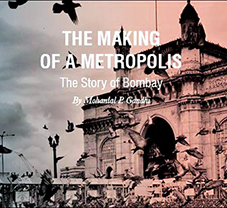 "Growing up, I always saw my father surrounded by books, deeply immersed in reading and writing. Though I instinctively understood that he was someone who wrote to explore and understand the world, I never took an interest in what exactly he was writing,” she stated in a press note about the work of her journalist and newspaper owner father. It was only after he passed away in 1996 that she espoused it as her passion. "It’s been a while in the making, but my father’s labor of knowledge and love is finally here.”
 "The project of bringing this manuscript to fruition is a labor of love for the author’s family,” stated publisher-businessman Maneck Davar. Terming the book, a "phenomenal historical work that captures the essence of the city,” Davar believes "the tome deserves widespread dissemination.”
The press release notes, "The publication aims to present a comprehensive overview of Bombay’s history, growth and development. It emphasizes the city’s geographical significance, scenic setting, and natural harbor, which have collectively propelled it to become the most populous and prosperous metropolis in the country.
"Furthermore, the book provides a chronological visual presentation of Bombay’s history, starting with a panoramic view of the city center and followed by sections on historical landmarks, trade and commerce, municipal services, and transportation infrastructure.”
The book was released by Kamath along with chief guest industrialist Nadir Godrej, guest of honor architect Hafeez Contractor, chief editor of Janmabhoomi Kundan Vyas, chairman of Maharashtra State’s Gujarat Sahitya Akademi, Snehal Mazoomdar and Davar.
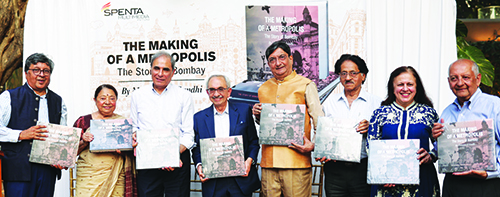
From l to r: Maneck Davar, Minaxi Kamath, Hafeez Contractor, Nadir Godrej, Snehal Mazoomdar,
Kundan Vyas, Dr Rati Godrej, Dr Rabindra Kamath
Terming the tome a monumental work of academia prepared at a time when there was no Internet, Davar revealed that the 299-page volume priced at Rs 2,950 contains many facts not previously unearthed, a tribute to Gandhi’s "excellence at research.” Davar intends bringing out the tome in Gujarati and in Marathi as well.
As is his wont, Godrej recited a 1,400-word ode to the city titled Bombay, the Financial Capital into which he wove the history and entrepreneurial spirit of the city. "A veritable cultural feast /Much progress we could see/ Thanks to the diverse society.”
Both New York and Bombay being centers of education, culture and art, the industrialist recited, "Big Apple is what they call New York./ Therefore going by this talk,/ We’re not crunchy but soft and sweet/ So don’t you think it would be neat / If Bombay took on as an appellation/ Big Mango, Urbs Prima of the nation!”
When Contractor read the book, he started seeing "how every calamity helped the city to grow… It is a great book for architects.” Of special interest to him was the chapter on slum development. He believes that given large scale reclamation, "all slum dwellers can be housed for free… Every Bombayite should get up and say, ‘Let’s do it… Let’s reclaim.’” Commending the vision of industrialist J. R. D. Tata for first promoting a trans-harbor link, Contractor recalled Lady Avabai Jamsetjee Jejeebhoy whose donation was instrumental in linking Bandra and Mahim via the causeway that bears her name.
"There cannot be a bigger tribute from a daughter,” stated Vyas, commending Kamath’s passion to make Gandhi’s work known to the world at large. He recalled various instances of the author’s assiduity and his strength of character.
Mazoomdar too lauded Gandhi’s research. "I just could not put the book down,” he stated describing it as a very "balanced” work. He cited interesting snippets from the book — the name Naigaon for the locality near Dadar is derived from Nyayagram, the location of the law courts of 13th century Raja Bhimdev who ruled over Mahim (then Mahikavati); that "Mazgaon” was probably derived from Matsyagram, the local term for a fishing village. "When I closed the book, the light opened,” stated Mazoomdar.
FARROKH JIJINA
◆ ◆ ◆
From the archive