
The Occasional Piece
Beleaguered ultras going berserk
The ultraorthodox have of late been feeling as devastated as the Gaza Strip. A former chairman of the Bombay Parsi Punchayet (BPP) has just been cremated. Behdin Pasbaans (laity trained to perform priestly duties) are performing the boi ceremony, the five times a day service of consecrated fires in fire temples. Interfaith married persons, alias heretic scum, have the temerity to lecture at religious occasions. This has convinced the ultraorthodox that the much predicted doomsday (by their in-house seers) is near.
More bad news for them may be in the offing. The Supreme Court may soon restore gender parity for the children of intermarried Zoroastrians. Heresy, blasphemy, sacrilege — they have been screaming shrilly and stridently on social media. When the majority remains silent, the fringe elements usurp the role of spokesmen for the community.
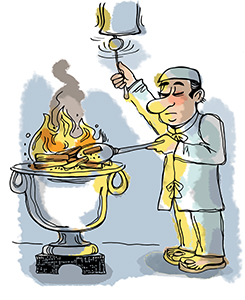 This time, however, their ire is directed at the mainstream orthodox who are cocking a snook at them with the introduction of the Behdin Pasbaan program. Since ordained priests are in short supply in Bombay and at agiaries in far flung areas, the program trains volunteers to perform boi and other ceremonies. In reality, an aged mobed snoozing on a bench in the backyard, after instructing the caretaker to perform the boi at the appointed hour, is a common occurrence. Sometimes the caretaker may not exactly be a Parsi. This has been happening informally in fire temples where the footfall of worshippers is minimal.
In rural and semi urban areas of Gujarat, an agiary may remain locked for days or even weeks when no mobed is available. Obviously, the fire is extinguished — a spiritual disaster for a consecrated fire. Hence the above mentioned Behdin Pasbaan program is an excellent initiative backed by, among others, a BPP trustee, Dr Adil Malia and, more significantly, Ervad (Dr) Ramiyar Karanjia, a scholar priest with impeccable conservative credentials. They know not what they do, lament the ultras in Messianic style.
For the ultras, housing two or more consecrated fires in a temple is taboo. They liken this to more than one king simultaneously holding court in the same kingdom. An unthinkable intermingling of jurisdictions, with unimaginable consequences. The ultras reel off all the gunahs (cardinal sins) the backers of the program are committing. These misguided souls, they sigh, will face terrible hurdles while crossing the Chinavat Pul, the bridge of judgment. Akin perhaps to the mental blockages the ultras themselves are experiencing.
When questioned about what the alternative is to training laymen and merging fires, the ultras choose to remain silent or refer to writings of the long deceased Khshnoomists, the Chiniwalla brothers and the teachings of their guru, Ustad Behramsha Shroff of Surat. (He was purportedly indoctrinated into the mysteries of occult Zoroastrianism by a White Hierarchy residing in an invisible township in the mountains of Demavand, Iran.) Shroff had predicted this precipitous decline of the faith due to widespread non observance of tarikat or rules of spiritual and personal conduct [a laundry list of prohibitions to avoid being spiritually polluted ranging from trimming nails after sunset and walking barefoot or bareheaded, to feeding cats (dogs are fine) to, well, exchanging bodily fluids with non Parsis].
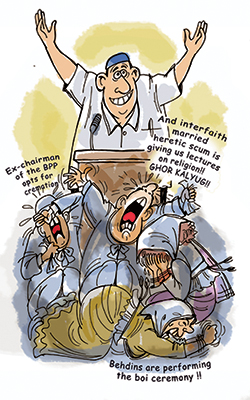
Kalyug or Kali Yuga, in Hinduism, is the period of darkness and sin.
It is the fourth, shortest and worst of the four yugas (world ages) in a Yuga Cycle,
preceded by Dvapara Yuga and followed by Satya (truth) Yuga.
Illustrations by Farzana CooperThe ultras are armchair critics who seldom take on the responsibility of becoming trustees of fire temples and community institutions. Many of them are educated, articulate and well read. They care for the community. Their in-depth research on Zoroastrian occult traditions is impressive for those who believe. They have no ulterior motive for the stance they hold. However, their fanaticism, often fanned by each other, makes them angry, frustrated, intolerant, abusive, and even irrelevant. The mainstream orthodox are nervous about offending the ultras and remain silent even when the latter are spewing drivel. The liberals mock them in private (it must be said that some of the ultras’ group chats are fascinatingly infuriating and unwittingly humorous). The rest of the community is indifferent or bemused. In the meanwhile, existential challenges mount.
In their obsession with doctrinal purity, the ultras are willing to jettison the most reasonable solutions. They may overlook an agiary not having a mobed — but creating paramobeds is sacrilege. If there is no doctor in the emergency ward, let the patient lie unattended — but the services of paramedics cannot be availed. An agiary may remain locked but housing its fire alongside another is not permissible. An ignorant mobed indulging in dubious conduct may have to be tolerated but a learned, chaste, non priest cannot enter the sanctum sanctorum to perform inner or outer liturgies. Unlike in Iran and in the West, having women mobeds is, of course, unthinkable. Anyone who begs to differ is assailed, abused. Even some traditionalist rank and file are now becoming disillusioned.
The vigilance of the ultras has helped preserve the community’s ethnic uniqueness. Throwing open fire temple doors to all or carrying out outright conversion, for social and political reasons, would indeed be disastrous. However, this does not justify their hostile opposition to the most pragmatic (a word they abhor) of solutions to the immediate and grave problems we face as an ethno religious group.
Assume that the dearly held belief of the ultras that supernatural great white Zoroastrians do indeed visit our fire temples and perform certain sacred rituals to strengthen and protect the holy fire is true. Does that imply the rest of us should not exert ourselves? Should we expect these divine beings to protect our fires around which the existence of the community and the faith revolve as never before? Arise from your armchairs and cast aside those blinkers please; we don’t want any surprises on the Chinavat bridge, do we?
Berjis Desai, lawyer and author of Oh! Those Parsis and Towers of Silence, is a chronicler of the community.
◆ ◆ ◆
From the archive