
Books
Paying for others’ sins
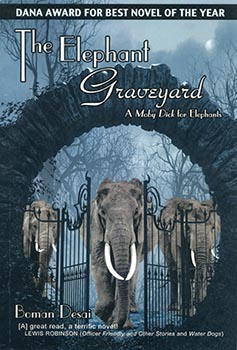
The Elephant Graveyard (A Moby Dick for Elephants) by Boman Desai. Published in 2022 by the author, email: boman@core.com. Pp: 303. Price: Rs 500.
If you want to know all about elephants, Boman Desai’s The Elephant Graveyard would be an excellent choice. The book is not only a compendium of interesting and enlightening facts about elephants but is also written is an extremely skillful and thought provoking manner. Though Desai must have delved deep into the history and habits of elephants, never once does the reader feel

Boman Desai: researching elephants
the weight of the research he has undertaken. All this information is gracefully provided and welded into the plot of the novel; never once does a person feel that one is reading a treatise on elephants.
According to legend, the elephant graveyard is a place where old elephants congregate as they approach the end of their lives. Elderly elephants who run out of molars and can no longer chew their food gather in places where they eventually die. Some believe that rapacious hunters may have lured the unsuspecting animals to certain spots where they were killed for their tusks.
Desai takes the reader to the vibrant and exciting world of a circus, which links several of his characters. The story opens in a circus in Ohio, USA, in 1948. There is all the excitement of acrobats, trapeze artistes, horses, clowns but the pièce de résistance is Hero, the blackest elephant in the world. However, the tinsel and sparkle effect is shrouded in some sort of tragedy in the Bailey family that runs the circus and has thereby cast a shadow on Dinty, a contortionist; Hazel, his daughter, who is famous for her star turn in the ring, being lifted with her head in Hero’s mouth; and Hazel’s one-time lover and a clown, Brown E, who quotes extensively from British playwright William Shakespeare, more often the gory and melodramatic lines.
The main protagonist is a spook, Daniel Patrick Bailey, who is called Spike, on account of his spiky hair. Desai portrays him as "a warm, endearing and loveable character” in spite of the fact that he has unknowingly murdered Prize. He is not a ghost like Nosferatu or a headless horseman, but just a young spook of 23 years — "a rattling of bones, dust and ash in a box in a graveyard” — and it is from this graveyard that Spike tells us the story of his life and his association with elephants.
The novel bursts forth with an unexpected event — Spike, on a pickpocketing spree with his friends, is the cause of the death of a young man who is trampled to death in a Toledo city square. The excitement continues: we encounter a king cobra in a Chicago penthouse, a striptease on elephant-back, slaves riddled with smallpox left on West African riverbanks to await crocodiles, a white elephant in musth — testosterone overdrive.
 Desai introduces us to another family, the de Bleus. The de Bleus are black and the mother has three children, Royale, who has done well for himself and is a lawyer in Chicago; Elbo who made his way into the world elbow first; and his unexpected twin, Prize, short for Surprise. Desai skillfully draws the two families together. Spike murders Prize at the beginning of the novel. Elbo finds his way into the circus and is befriended by Spike’s sister Hazel, who falls in love with Royale de Bleu.
Desai explains in his Afterword that he looked continually for ways to link India with the USA, a link which he found in the elephant, Hero, born in India and transported to a circus in the USA. Writing about this single animal led him to Herman Melville’s Moby Dick. Rereading the classic, he used Melville’s incantatory prose to propel him into flights of his own fancy. Not only does Desai manage to create the cadences of Melville’s prose but also laces his plot with several parallels with Moby Dick. "Call me Ishmael,” for instance, becomes "Call me Spike.” Melville’s Ahab loses a leg to a white whale, Desai’s Quint, his arm to a white elephant; Ishmael and Spike travel halfway around the world to meet their destinies. The novel has rightly been subtitled as A Moby Dick for Elephants.
In 1948, racism was even more prevalent than it is today, no less in India than in the US. Researching elephants, Desai establishes a link between the slaughter of the pachyderms for ivory and the slave trade. Africans were hired first by Arabs, then Europeans and Americans, to haul ivory from the interior of Africa to the coasts, whereupon they were enslaved, becoming commodities themselves. This racism is seen not only between the Blacks and the white Americans as is embodied in the relationship between Hazel and Royale, but also in India where Siri, the mahout who is looking after the elephant and who comes from Kerala and presumably must be darker than the average Indian, discriminates against Elbo who is black.
But The Elephant Graveyard is Desai’s spiritual novel — perhaps the most difficult to communicate in layman terms for the same reason. There is a serious side to the book — a metaphysical and a mystical one. Compared to his earlier novels, The Elephant Graveyard is more serious and philosophical. It is not an easy read but then the rewards are more satisfying as well. Desai quotes English poet John Donne’s religious sermon, "No man is an island” and refers to American writer John Steinbeck’s sentence where he mentions each one of us has got a little piece of a soul, but it is no good unless it is with all the other little pieces. One of the novel’s major preoccupations is the unity of all living organisms; Gupta, whose visiting card Spike finds during the pickpocketing spree and whom he visits in Bombay, suggests that we are all part of "one big soul.” Once you accept this then it follows "that we are paying for one another’s sins. I do something wrong, you are paying for it; if you do something wrong someone else is paying for it.” Desai makes the point that our lives are ruled by "cause and effect” and not "sin and redemption” or "crime and punishment.” We are all one, we pay not for our own sins but we are collectively responsible for the wrongdoings of others. As a result of this bad things do happen to good people and this has to be accepted. There are several such instances in the novel and this is in fact evident from the very first scene where an innocent Prize loses his life for no fault of his own.
Desai has undertaken an extremely difficult task and whether or not he has succeeded to link the notion of karma with the rest of the story remains for the reader to determine. English writer Graham Greene believed that once an author captivated the reader with a strong plot, he could convince the latter about the more serious aspects he wanted to convey. Desai follows a similar path. He manages to introduce his philosophy and buttress it with so many exotic and horrific events that the novel makes for a thrilling read.
FIRDAUS GANDAVIA
According to legend, the elephant graveyard is a place where old elephants congregate as they approach the end of their lives. Elderly elephants who run out of molars and can no longer chew their food gather in places where they eventually die. Some believe that rapacious hunters may have lured the unsuspecting animals to certain spots where they were killed for their tusks.
Desai takes the reader to the vibrant and exciting world of a circus, which links several of his characters. The story opens in a circus in Ohio, USA, in 1948. There is all the excitement of acrobats, trapeze artistes, horses, clowns but the pièce de résistance is Hero, the blackest elephant in the world. However, the tinsel and sparkle effect is shrouded in some sort of tragedy in the Bailey family that runs the circus and has thereby cast a shadow on Dinty, a contortionist; Hazel, his daughter, who is famous for her star turn in the ring, being lifted with her head in Hero’s mouth; and Hazel’s one-time lover and a clown, Brown E, who quotes extensively from British playwright William Shakespeare, more often the gory and melodramatic lines.
The main protagonist is a spook, Daniel Patrick Bailey, who is called Spike, on account of his spiky hair. Desai portrays him as "a warm, endearing and loveable character” in spite of the fact that he has unknowingly murdered Prize. He is not a ghost like Nosferatu or a headless horseman, but just a young spook of 23 years — "a rattling of bones, dust and ash in a box in a graveyard” — and it is from this graveyard that Spike tells us the story of his life and his association with elephants.
The novel bursts forth with an unexpected event — Spike, on a pickpocketing spree with his friends, is the cause of the death of a young man who is trampled to death in a Toledo city square. The excitement continues: we encounter a king cobra in a Chicago penthouse, a striptease on elephant-back, slaves riddled with smallpox left on West African riverbanks to await crocodiles, a white elephant in musth — testosterone overdrive.
Desai introduces us to another family, the de Bleus. The de Bleus are black and the mother has three children, Royale, who has done well for himself and is a lawyer in Chicago; Elbo who made his way into the world elbow first; and his unexpected twin, Prize, short for Surprise. Desai skillfully draws the two families together. Spike murders Prize at the beginning of the novel. Elbo finds his way into the circus and is befriended by Spike’s sister Hazel, who falls in love with Royale de Bleu.Desai explains in his Afterword that he looked continually for ways to link India with the USA, a link which he found in the elephant, Hero, born in India and transported to a circus in the USA. Writing about this single animal led him to Herman Melville’s Moby Dick. Rereading the classic, he used Melville’s incantatory prose to propel him into flights of his own fancy. Not only does Desai manage to create the cadences of Melville’s prose but also laces his plot with several parallels with Moby Dick. "Call me Ishmael,” for instance, becomes "Call me Spike.” Melville’s Ahab loses a leg to a white whale, Desai’s Quint, his arm to a white elephant; Ishmael and Spike travel halfway around the world to meet their destinies. The novel has rightly been subtitled as A Moby Dick for Elephants.
In 1948, racism was even more prevalent than it is today, no less in India than in the US. Researching elephants, Desai establishes a link between the slaughter of the pachyderms for ivory and the slave trade. Africans were hired first by Arabs, then Europeans and Americans, to haul ivory from the interior of Africa to the coasts, whereupon they were enslaved, becoming commodities themselves. This racism is seen not only between the Blacks and the white Americans as is embodied in the relationship between Hazel and Royale, but also in India where Siri, the mahout who is looking after the elephant and who comes from Kerala and presumably must be darker than the average Indian, discriminates against Elbo who is black.
But The Elephant Graveyard is Desai’s spiritual novel — perhaps the most difficult to communicate in layman terms for the same reason. There is a serious side to the book — a metaphysical and a mystical one. Compared to his earlier novels, The Elephant Graveyard is more serious and philosophical. It is not an easy read but then the rewards are more satisfying as well. Desai quotes English poet John Donne’s religious sermon, "No man is an island” and refers to American writer John Steinbeck’s sentence where he mentions each one of us has got a little piece of a soul, but it is no good unless it is with all the other little pieces. One of the novel’s major preoccupations is the unity of all living organisms; Gupta, whose visiting card Spike finds during the pickpocketing spree and whom he visits in Bombay, suggests that we are all part of "one big soul.” Once you accept this then it follows "that we are paying for one another’s sins. I do something wrong, you are paying for it; if you do something wrong someone else is paying for it.” Desai makes the point that our lives are ruled by "cause and effect” and not "sin and redemption” or "crime and punishment.” We are all one, we pay not for our own sins but we are collectively responsible for the wrongdoings of others. As a result of this bad things do happen to good people and this has to be accepted. There are several such instances in the novel and this is in fact evident from the very first scene where an innocent Prize loses his life for no fault of his own.
Desai has undertaken an extremely difficult task and whether or not he has succeeded to link the notion of karma with the rest of the story remains for the reader to determine. English writer Graham Greene believed that once an author captivated the reader with a strong plot, he could convince the latter about the more serious aspects he wanted to convey. Desai follows a similar path. He manages to introduce his philosophy and buttress it with so many exotic and horrific events that the novel makes for a thrilling read.
FIRDAUS GANDAVIA
Gandavia holds a doctorate in English literature and is a retired chartered accountant. He is a compulsive reader of fiction.
◆ ◆ ◆
From the archive