
Zoroastrians Abroad
Gifting a garden
An Iranian garden is meant to be "provocative and educational, in a way that distinguishes it from the amusement space of the park,” noted a write-up on the inauguration of the Damghan Iranian Garden in the Semnan province (in the north of Iran) on June 2, 2021. "We noticed this sort of a questioning look on the faces of the visitors. It was as if they had set foot in a mysterious, sacred and magnificent place. Achieving this feedback was the most important goal for us,” architect Khoobchehr Keshavarzi was quoted in an article in the online news portal amordadnews.com. She was given credit for designing the Garden along with her husband Yazdan Houshvar, an architect and urban planner.
With the Garden created in the Damghan Forest Park spread over 18.5 hectares (1,85,000 sq m), Keshavarzi was particular that no tree would be axed for this project. Even the entrance was designed around a tree standing in the area. Enhancing the greenery at this Garden are the nastaran (sweetbriar) plants at the entrance and exit. "Today we know that the nastaran flower is a symbol of Amardad Ameshaspand and a symbol of immortality. We also know that Amardad Ameshaspand is the guardian of plants and vegetables,” mentioned Keshavarzi.
With the Garden created in the Damghan Forest Park spread over 18.5 hectares (1,85,000 sq m), Keshavarzi was particular that no tree would be axed for this project. Even the entrance was designed around a tree standing in the area. Enhancing the greenery at this Garden are the nastaran (sweetbriar) plants at the entrance and exit. "Today we know that the nastaran flower is a symbol of Amardad Ameshaspand and a symbol of immortality. We also know that Amardad Ameshaspand is the guardian of plants and vegetables,” mentioned Keshavarzi.
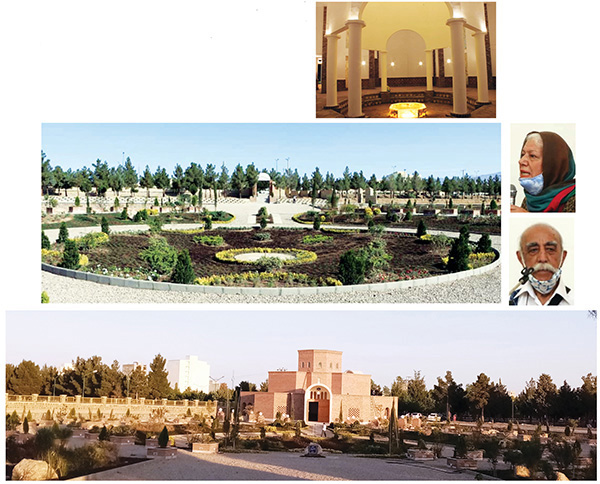
Clockwise from above (r): Khoob-chehr Keshavarzi, Yazdan Houshvar,
views of the Damghan Iranian Garden and pavilion in Iran Photos: amordadnews.com
Financed by Ali Akbar Kianpour, this first garden in Semnan province honors the traditional and domestic architecture of the country. "In the middle of the Garden, there is a pool of water and a waterway. Water, indicating the flow of life and existence, is the most fundamental symbol for a place that is supposed to be called a garden,” believes Keshavarzi.
The Garden includes a pavilion and the Manouchehri Square where the 11th century poet Manouchehr Damghani’s statue will be installed in September. At the Square, Keshavarzi specially planted the evergreen and sweet smelling myrtle plant which has medicinal use. As explained by Keshavarzi, "The Iranian pavilion is designed in the shape of a flower, but when you enter, you think you are entering a classic Iranian architecture. The shape of the flower is reflected in the ceiling and all its various sections. A marble pool that looks like a bright gemstone adds to the lighting effect. The same can be seen on the ceiling with a view of the sky. The central part of the pavilion has no windows. On four sides are tall marble stones that light up at different times of the day depending on the direction of the sunlight.
Keshavarzi was keen that the UNESCO-announced 10 criteria for declaration of a garden as a heritage site be incorporated in the Damghan Iranian Garden. Involved with the Persian Garden Institute for Living Heritage that is accredited by UNESCO, she has reportedly done considerable research on the subject of Persian gardens and presented her findings in the form of lectures and articles.
Citing Borhan-E Qate (Encyclopaedia Iranica), she mentioned that baug that is translated as garden, etymologically stems from the word baag, meaning donate or give away in Avestan, and hence is equated with God who is considered the greatest giver.
◆ ◆ ◆
One reader wrote
Loved reading this. Please give more news about Zoroastrians in Iran whenever possible
From the archive