
Trusts
Cumbersome for charities
Community institutions in India receiving overseas funds are left with four months to complete formalities necessitated by the amended Foreign Contribution (Regulation) Act
Despite the new tedious formalities mandated by the amended Foreign Contribution (Regulation) Act (FCRA), 2020, the flow of funds to community institutions and trusts is not expected to be impacted. This opinion was expressed by Homa Petit, president of the B. D. Petit Parsee General Hospital (PGH), Dr Vispi Jokhi, chief executive officer of Masina Hospital and Dinshaw Tamboly, chairman of The World Zoroastrian Organisation Trust (WZOT) and The WZO Trust Funds (WZOTF), ,both of which are registered under FCRA. They were responding to queries raised by Parsiana to determine the repercussions the amended FCRA 2020 will have on Parsi founded trusts and nongovernmental organizations (NGOs), particularly when grappling with the prevailing pandemic.
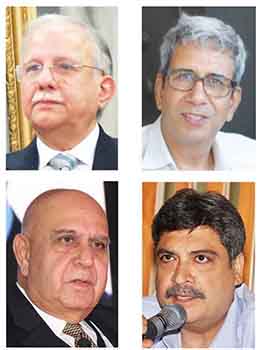
Clockwise from top l: Homa Petit, Dr Vispi Jokhi,
Noshir Dadrawala, Dinshaw Tamboly
Anticipating "initial hiccups and difficulties till the processes are understood down the chain,” Petit referred to facing challenges during the month of October "as there was no clarity on the process with some of our donors’ bankers refusing to remit funds and our recipient bankers not crediting funds to our existing FCRA accounts.”
When overseas donors forward funds for a earmarked purpose, delays in processing the funds "may deter the donor from contributing meaningfully,” pointed out Jokhi. He commented that the "new FCRA regulations are a source of worry as the documentation is now more cumbersome… The most cumbersome aspect of this is the opening of a bank account with the State Bank of India (SBI), Delhi branch. The (required) clearance from the Ministry of Home Affairs (MHA) and the powers conferred on them to arbitrarily suspend the FCRA licence and give reports to them…can be a problem.”
With all NGOs/trusts being required to comply with the new regulations by March 31, 2021, "at the very least it will increase the workload as fresh bank accounts will have to be opened with SBI, Delhi, receive remittances into the Delhi Bank account, thereafter transfer them to our existing bank at Bombay, fill in additional forms, submit them electronically at set intervals to the FCRA website. Whether the new regulations cause any further impact, we will know only after the new system has been implemented,” cautioned Tamboly.
"Government is well within its rights to ‘regulate’ civil society organizations (CSOs). However, it has absolutely no right to ‘control’ or dictate which bank the FCRA account should be opened with, nor prevent one registered and compliant organization from contributing to another registered and compliant organization, nor control how much the cap on admin expenditure should be,” responded Noshir Dadrawala, Centre for Advancement of Philanthropy program director, legal and corporate social responsibility compliance.
As he further elaborated, MHA has amended section 7 of FCRA 2010 such that a registered (under FCRA) recipient of ‘Foreign Contribution’ in India cannot transfer (grant or sub-grant) foreign funds to any other institution, even if the latter is registered under FCRA. This amendment is a major blow to NGOs working collaboratively on projects and programs as also to subsidiaries of overseas donors and intermediaries which have been funding medium to small implementing agencies. This change may not affect Parsi trusts registered under FCRA and implementing programs, projects and activities directly on their own, be it towards advancement of education or medical relief, etc. However, organizations registered under FCRA but receiving foreign funds through intermediaries like WZOTF may be affected unless overseas donors change their policy and decide to send funds directly to these small implementing charities.”
Among the other amendments introduced in the revised Act is the 20% cap on administration expenses. Earlier institutions were allowed to spend up to 50% of foreign funds received during the fiscal year on administrative expenditure. MHA will now also have the power to freeze the FCRA bank account for as long as 360 days in case of any contravention of the FCRA law after holding a ‘summary inquiry.’ In case FCRA is cancelled by MHA or even on voluntary surrender of FCRA registration, assets created out of foreign contributions have to be vested in the competent government authority.
Generally, renewal of FCRA registration has been relatively easy for organizations that have been compliant with requirements like filing annual returns, quarterly intimation of overseas funds, etc. Before renewing the certificate, MHA is now entitled to make enquiries as it deems fit to satisfy itself that the organization has fulfilled all conditions.
Dadrawala was emphatic, "Every NGO/NPO (non-profit organization)/CSO is independent where matters concerning internal governance are concerned. Fines and penalties may be imposed for compounding certain irregularities such as not filing returns on time. NGOs may also be subject to random financial assessments by the regulatory authorities. There is no need to add new laws or amend existing laws or add more compliance requirements considering that the government has enough powers to ‘investigate’ those it believes are not transparent enough through the Comptroller Auditor General (CAG) and Central Bureau of Investigation agents.”
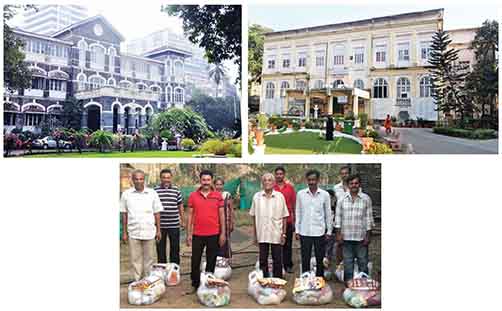
Clockwise from above l: The B. D. Petit Parsee General Hospital; Masina Hospital;
beneficiaries receiving support from The World Zoroastrian Organisation Trust
Diversion of donations
Donors who may have temporarily chosen to use their limited funds to assist victims of the pandemic will in due course start supporting community institutions again. "Considering the yeoman work the Hospital is doing for the community,” Petit was confident the original donors will once again extend their philanthropy. In the meantime, the PGH management is discussing "supplementation of our revenue and measures to control costs and reduce unnecessary expenditure.”
At Masina, Jokhi observed that donor trusts whose offices are closed due to the pandemic or trustees who are "not used to digital transactions… have resulted in them postponing or deferring donations to our Hospital.”
For WZOT and WZOTF’s efforts to provide relief and rehabilitation to those affected by the pandemic, the Zoroastrian Charity Funds of Hongkong, Canton and Macao (ZCFHCM) have, till mid-November 2020, "sent donations valued at Rs 23,075,000 which amounts to 46% of total donations received so far (Rs 50,214,968). In addition, three individuals from Hong Kong have between them remitted Rs 21,369,000 for the pandemic which amounts to 42.5% of total donations received so far. Thus, Hong Kong, through their association and magnanimous individuals has contributed 88.5% of total donations received for the pandemic effort,” acknowledged Tamboly.
Between April and mid-November, 2020, Tamboly noted they had provided food grains to 2,967 families; extended financial support to 850 families on an all India basis who have been financially affected by way of jobs lost, salaries reduced, businesses of self-employed individuals having suffered losses, income of mobeds, and agrarians residing in rural areas affected. They further extended financial support to two hospitals, one each at Bombay and Navsari to set up Covid care facilities.
The ZCFHCM further sanctioned Rs 5,000,000 for the purchase of 125 laptops for children from economically challenged Zoroastrian families thereby enabling them to continue their education. With virtual online education being the norm, children from economically challenged homes were unable to pursue their education as their families could not afford to buy them tablets or laptops; some could afford only basic mobile phones with which it was very difficult to follow online education, and there have been quite a few families who could not afford even these mobile phones. Continuing their education was the best possible gift these children could have ever received, added Tamboly.
Neville Shroff, president of ZCFHCM, is "very keen that other organizations also assist WZOT with significant funding to alleviate the extreme poverty and distress during these unprecedented times of the pandemic,” conveyed Tamboly appealing to "high net worth individuals, and charitable trusts in India and abroad, who may wish to consider extending support like Hong Kong. Should they so wish, they themselves can undertake to provide succour to those affected by the pandemic. Had it not been for the inflow of funds from Hong Kong, the plight of community members in India would have been very different,” he reiterated, viewing the community in Hong Kong as "champions of philanthropy.”
Successive lockdowns when people were watching more television, consuming more news or doomscrolling as is the new jargon, has resulted in a surge of philanthropy in India, according to Ingrid Srinath, director of the Centre for Social Impact and Philanthropy at Ashoka University who was quoted in The Times of India on November 22, 2020 in a front page article titled, "Indians open up hearts and wallets in pandemic.” Crowdfunding platforms like ImpactGuru reported the current preference to support Covid treatment has resulted in their receiving an average 2.5 donations per minute. Known for their legendary largesse, Parsis too should count among such caring citizens.
◆ ◆ ◆
From the archive