
Events & Personalities
Popularizing stitches
"It was a privilege that on the first day of the exhibition, many of (my) creations were chosen and bought for some museums in India,” couturier and designer Zenobia Davar wrote in an email to Parsiana about a showing of her creations at the Paramparik Karigar exhibition at the World Trade Centre in August 2019. (Paramparik Karigar is the brainchild of the late Roshan Kalapesi who, along with various artisans, worked towards keeping various traditional crafts alive in their original form.) A workshop for the Frohar Foundation’s Zoroastrian Saga at J. B. Vachha School, "where 23 enthusiastic participants learnt the art (of embroidery) was followed by a competition where 25 contestants took part,” she wrote. Workshops and exhibitions at the Prince of Wales Museum (now Chhatrapati Shivaji Maharaj Vastu Sangrahalaya), Sophia College and St Xavier’s College also kept Davar busy in August.
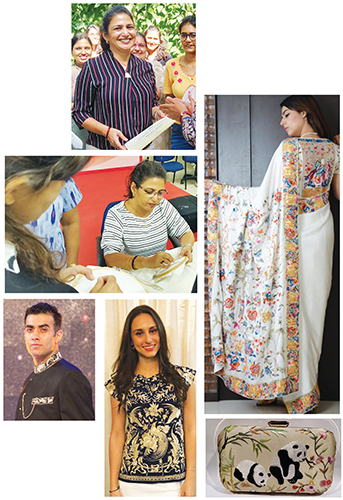
Top and center Zenobia Davar with a collection of her creations
At the invitation of the Indian Heritage Centre (IHC) of the ministry of external affairs, Davar was invited in March this year to hold demonstrations and workshops at a museum under the National Heritage Board, Singapore. Titled "Kala Sangam,” the IHC initiative focussed on promoting the intangible cultural heritage of Singapore’s Indian community. "It was a wonderful platform for showcasing my creations... and teaching various intricacies of the embroidery.” Thirty-six people attended the workshops, the designer noted. Creating and restoring authentic garas was the focus of Davar’s talk to the Parsis of Singapore at Zoroastrian House, she stated.
"We work hard and give our all to preserve our culture and heritage by keeping alive the dying art of gara embroidery,” said Davar, in conversation with Parsiana in early December. "Very few people do real handmade gara embroidery these days. Most of the work is machine made or done with the less complicated and speedier ari stitch,” which is not the way original garas were made, she explained. Keen to showcase to discerning buyers the authentic stitches used in her creations, Davar said she is keen to make the "dying art” of the original stitch popular again. "It is up to us to preserve our heritage,” she signed off.
◆ ◆ ◆
From the archive