
Observation
Looking forward to a lagan
Despite changing trends the Parsi wedding celebrations still retain their traditional charm
One of the things I miss most from my childhood in Bombay is the ultimate Parsi wedding! Not the bland modern Parsi weddings celebrated at trendy venues with DJs spinning the music, and waiters walking around serving little appetizers, and with dishes like butter chicken and Thai curry on the menu. No, I mean our traditional Parsi lagan, dhoom-dham thi, celebrated at Allbless Baug, Cama Baug or Colaba ni Agiary.
The excitement begins with the lagan nu téru (wedding invitation) which arrives in its thick envelope around two months before the event. Mummy immediately RSVPs, and right away marks the date on the Parsi Dairy Farm calendar hanging inside her cupboard door (even though the date is permanently etched on her brain). Dad gets his daily reminder to come home early on the day so we can make it on time. What with the traffic on Bombay streets, the commute to Allbless Baug could very well take over an hour!
One day before the event, after a lengthy, animated, typical bawa-style argument over whether mum should wear her diamonds (too predictable) or her pearls (too boring), we all agree on the sapphire set, and the special janas (jewelry) in its dark blue velvet case is brought home from the bank locker, and we girls ooh and aah over it.
At the bank, dad has a major palaver with the teller and makes sure he gets only the most crisp (kori, karak) bank notes for the pehramni (gift). Nothing short of a note straight from the mint will do! Settling on the right amount of pehramni requires skill and finesse. You know that the amount given is going to be neatly documented by the bride’s and groom’s families for future reference! Give too modestly and you look cheap, give too much and you’re showing off! The amount you give should reflect how well you know the bride’s or groom’s families. Your own family’s pehramni register must be cross-referenced to see if any of them came for your functions, and how much they gifted you. Then, considering whether you are still on speaking terms with their Firoze masa (uncle), or best friends with the bride’s sister-in-law, or how many times their car was parked in your spot, the final amount is computed. And, you must make sure it is just slightly more than they gifted you. Let them know very subtly that you value them just a little more than they value you! And can afford to show it!
The excitement begins with the lagan nu téru (wedding invitation) which arrives in its thick envelope around two months before the event. Mummy immediately RSVPs, and right away marks the date on the Parsi Dairy Farm calendar hanging inside her cupboard door (even though the date is permanently etched on her brain). Dad gets his daily reminder to come home early on the day so we can make it on time. What with the traffic on Bombay streets, the commute to Allbless Baug could very well take over an hour!
One day before the event, after a lengthy, animated, typical bawa-style argument over whether mum should wear her diamonds (too predictable) or her pearls (too boring), we all agree on the sapphire set, and the special janas (jewelry) in its dark blue velvet case is brought home from the bank locker, and we girls ooh and aah over it.
At the bank, dad has a major palaver with the teller and makes sure he gets only the most crisp (kori, karak) bank notes for the pehramni (gift). Nothing short of a note straight from the mint will do! Settling on the right amount of pehramni requires skill and finesse. You know that the amount given is going to be neatly documented by the bride’s and groom’s families for future reference! Give too modestly and you look cheap, give too much and you’re showing off! The amount you give should reflect how well you know the bride’s or groom’s families. Your own family’s pehramni register must be cross-referenced to see if any of them came for your functions, and how much they gifted you. Then, considering whether you are still on speaking terms with their Firoze masa (uncle), or best friends with the bride’s sister-in-law, or how many times their car was parked in your spot, the final amount is computed. And, you must make sure it is just slightly more than they gifted you. Let them know very subtly that you value them just a little more than they value you! And can afford to show it!
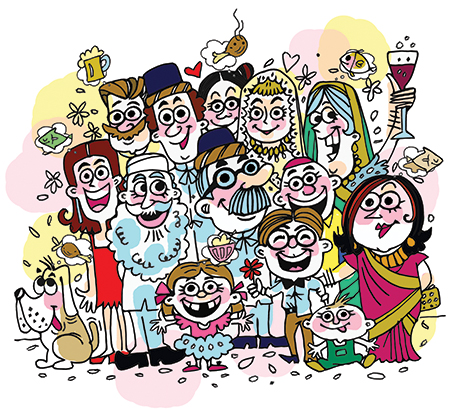
Illustration by Farzana Cooper
On the actual day, my older sister (a typical teenager) issues a stern warning to me to make sure I do not wear anything remotely resembling her outfit — she is quite the fashionista. Which is quite a problem for me, as she discards outfit after outfit for ages before settling on the ‘perfect’ one, leaving me about 15 minutes to figure out what I am wearing! But I am not too concerned — I know she will spend at least another half hour ironing her hair and adding the correct accessories. Mummy’s sari is carefully unwrapped from the dry-cleaner’s brown paper wrapping, and there is a big argument (Parsis never make even the smallest decision without an argument — or ‘discussion’ as we like to call it) about whether dad should wear a dagli or a suit! Mum favors the traditional dagli, my sister and I want him to be a bit stylish and wear a suit. My dad would rather go in a shirt and pant and sandals (infinitely more practical in the sweltering Bombay heat). Obviously, the poor man doesn’t get his way, and in an hour or so, we are all dressed and in the car, sweating in our fancy silks and brocades during the long drive to Allbless Baug! The car has to be parked a mile away — all the parking spots close by are taken, and as he drops us off at the main entrance, my dad grumbles on and on about how we are always late getting dressed, and how he will have to drive around to find a parking spot.
The deafening sound of pop music blasting from loud-speakers — so loud that it even overpowers the unceasing orchestral din of car horns that is the soundtrack to life in Bombay — assaults us at the entrance, probably rendering irreparable damage to the hearing of the gherwallahs (families of the couple getting married) who wait there patiently with smiles pasted on tired faces to welcome us. The entrance is decorated with sweet-smelling torans — roses and chameli and mogra intertwined into thick ropes. Even the toxic Bombay air is fragrant with their heady perfume.
 The first thing we do is head to the long queue waiting to greet the newlyweds and their families, and hand over the pehramni nu packet. Our turn finally comes, and we step on to the flower-decked stage where the bride and groom are sitting stiffly on their chairs, with both sets of parents next to them, and an aunt on one end who stashes the gifts in a large bag in a very business-like way. The bride’s mother is smiling: ‘Thank God my Roshni is safely off the marriage market, now there is no need for me to be sickly sweet to those smug women with eligible sons!’ The groom’s mother is smiling too: ‘Thank God there is now somebody else who will pick up Viraf’s dirty socks and take care of his never-ending demands and whining all day!’ The bride’s father is frowning as he wonders how much of the cost the pehramni will cover. The groom’s father is smiling, thinking of the ‘bottles’ safely stashed in the hall. And the poor bride and groom are pretending to smile at every koyla (stale) Parsi joke each would-be comedian (and there is no dearth of those in our community) makes about the wedding night!
That ordeal over, my sister and I head quickly towards the band. The music is standard Parsi fare — Viva Espana, Congratulations, Delilah, Knock Three Times, La Bamba, no matter what year or even decade it is. The little space close to the stage is filled with bawas dancing very enthusiastically and having a great time — children, oldies, and even a few very energetic young couples. (I have to add here that our father, a classical music fanatic, seriously dampened the pleasure of my sister’s and my navjote by insisting on having the Police Marching Band for my sister’s navjote and the Navy Orchestra for mine! Instead of having a fun time with a lively band, our friends just sat glumly the entire time, and it was a long, long time before we got over it or forgave him!) Other guests sit in little groups and ridicule the dancers, criticize what everybody is wearing, and indulge in our very favorite pastime — gossip! There is always a tiny group of non-Parsis — work colleagues of the fathers, sitting very seriously in a corner and looking self-conscious, and completely overwhelmed to see their strict and serious workaholic boss behave like a party animal! And there is generally a young noisy, boisterous group as well — work or college friends of the bride and groom, who are having a really good time together.
Once the crowd around the happy couple begins to dwindle, guests make their way towards expensive Scotch, vodka, gin, a few bottles of wine, soda, and ice cubes melting in the unbearable heat. The drinking revelry is interrupted however, with a clarion call over the microphone to proceed for dinner, "Banoo-o né grashto, jamvaa chalo ji.” And like a herd of wild elephants stampeding across the Serengeti, the 400+ bawas charge towards the neat rows of dining tables set up at the far end of the Baug. Chairs are pushed over, purses forgotten, soft drink glasses overturned, and people shoved out of the way with fierce jabs of the elbow as each person is determined to make it for the first seating, lest the caterer run out of food! Even Olympic gold medalist sprinter Usain Bolt would be left eating the dust of a Parsi opponent if a table packed with Godiwala nu lagan-nu-patru was waiting at the finishing line.
The caterer takes charge now, with a staff well trained to deal with the most demanding Parsi guest (and there are a lot of those). Like a perfectly choreographed dance, two servers lay the patras (plantain leaves) and cutlery on the tables. Then follow two more with the sarya (sago wafers) and lagan nu achaar (sweet pickle). Immediately behind them, appear the soft drinks — naturally Duke’s or Roger’s, carried in buckets filled with ice. You can choose between the bright red raspberry or the in-demand orange or the sickly yellow lemon-soda or something poisonously green although I have no idea what that flavor is meant to be. The more cautious select plain soda or the popular ginger ale to help settle the tummy after the abuse it will take.
Once the preliminaries are completed, everyone looks forward to the main act. Will it be marghi na farcha (chicken fried in batter) or kid roast? Followed by patra ni machhi (fish wrapped in a plantain leaf) or machhi no sas (fish in white sauce)? And then of course the much awaited lagan no pulao. With everybody hoping for second servings of each. The wait-staff patiently deals with constant cries of "Give me the leg piece,” "Put another piece of fish; why are you being so kanjoos (stingy)?” "Dikra (son), let me choose my boti (piece of meat),” "Arré wadharé dar nakhni (put more dal).”
Then comes the finale with either lagan nu custard or Parsi Dairy kulfi, followed by little white cardboard trays of sweets and paan for each guest. Soon everybody is smiling, sated and satisfied.
While the guests are busy stuffing their bellies, the happy couple and assorted family members make the rounds, shaking sticky hands (the guests’, not theirs — they will have to wait patiently for the third and final seating), asking each guest if they liked the food. "Wonderful, but I think kid roast would have been a better choice than the farcha.” "Delicious, but the pulao seemed a bit dry.” Parsis feel that they owe the hosts their brutally honest and "expert” critique!
Lethargic after that magnificent meal, goodbyes are said, promises to keep in touch made, phone numbers exchanged, and the guests slowly make their way home. Back home, mum takes charge of our fancy clothes, and we say goodnight and head to bed, hoping for another lagan nu téru very soon.
◆ ◆ ◆
From the archive