
Intentional communities
"Over the centuries, Zoroastrians in Iran have shaped societies that are now known as ‘intentional communities.’ In these communities they try to live with an alternative lifestyle that is different from the dominant culture and only those who accept this lifestyle and its principles can join this community,” explained Radman Khorshidian (pictured) in his paper presented on June 2, 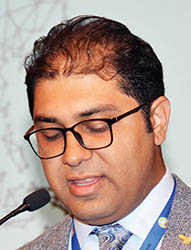 2018 at the 11th World Zoroastrian Congress in Perth. In his thesis for the second level Master of Social Foresight at the University of Trento in Italy he explored "Intentional Communities Network (ICN) and future: a complex adaptive systems (CAS) analysis.”
As he further elaborated in the Congress brochure, Zoroastrian society in Iran "can be considered a collection of intentional communities that try to live (a life) based on Zarathushtra’s ideology… They attempt to ameliorate perceived social problems with consciously devised sociocultural, political, economic or spiritual alternatives.”
In Yazd, the community members resided in separate villages that led to a network of Zoroastrian settlements that were independent from each other yet closely interrelated. To organize their society they depended on the natural human system and ecology as also artificial systems like parallel computing systems and artificial intelligence systems. According to Khorshidian’s analysis, the Zoroastrian settlements network that saves cultural and language diversity is robust and therefore even if a part of the system were to be destroyed, it would continue to function. This allows Zoroastrian communities to remain in difficult conditions and adapt to it.
To prepare for the future the "world Zoroastrian societies need to be able to adapt creatively” using communication and transportation technologies that could result in "a new phenomenon named World Zoroastrian Intentional Communities Network (WZICN),” recommended Khorshidian. This network would be characterized by "diversity, interconnectivity and autonomy.” The spread of these communities throughout the world could help other people understand how the Zoroastrian principles of honesty, respect for nature and benevolence can be adopted for a sustainable and happy society.
"What would this accomplish for Zoroastrians?” Khorshidian asked the audience before proceeding to answer, "On a daily basis it would facilitate the practice of living with the teachings of Zarathushtra; create utopian Zoroastrian communities; result in diversity of culture; promote adaptability.”
Nothing concrete happened. The Perth gathering was simply a merry get together with some prizes distributed and speeches made without delving on the core issues. Core issues facing the community threatening its very existence such as causes of dwindling population, late marriages, inter caste marriages,properties of the community being encroached and in many cases taken over by non Zoroastrians,children of inter caste marriages and their navjote, non Zoroastrian spouses right to follow Zoroastrian, difference between being a Parsi and a Zoroastrian,connectivity with the Zoroastrians of Kurdistan, Tajikistan, Azerbaijan and other places, very high rates of divorce and estrangement, increasing numbers of homosexuals and how this has to be dealt with and a host of other issues were not discussed. It would be worthwhile to have statistics on some these core issues to know in which direction the community is headed in India, Iran, USA and other places.