
Unforgettable Bawas
The accountant
His father was the dreaded headmaster of the local Gujarati medium charity school; both feared and adored by generations of students. His integrity was legendary. The headmaster was harsher with his own children. His son though was a bright lad by the standards of that sleepy town and managed a scholarship in Bombay. Those were the early days of chartered accountancy in India. Senior income tax officers were automatically designated as chartered accountants without being required to pass any arduous exam. Even after an exam becoming mandatory, it was relatively easy to pass in the first five years. The lad just managed to scamper through and landed a job in one of the many Parsi owned CA firms.
Endowed with a pleasing personality and a rowdy sense of humor, he charmed the mostly Parsi and Gujarati clients of his rather foul tempered boss. His boss reminded him of his honest father who had died a few years ago in abject poverty. Silly, old duffer would not even gift dry fruits to the tax officers and was agitated when his clients received unconscionable demands to pay tax. The clients though began to love the young assistant who would obtain the most favorable orders. They did not really mind paying a little extra cash to the young man. The old dodger soon discovered the antics of his assistant and said, with an expression on his wrinkled face as if he had swallowed unrefined castor oil, that he did not expect this from a Parsi, and that too from the son of the great headmaster. The assistant resigned. Most of the clients followed him.
Endowed with a pleasing personality and a rowdy sense of humor, he charmed the mostly Parsi and Gujarati clients of his rather foul tempered boss. His boss reminded him of his honest father who had died a few years ago in abject poverty. Silly, old duffer would not even gift dry fruits to the tax officers and was agitated when his clients received unconscionable demands to pay tax. The clients though began to love the young assistant who would obtain the most favorable orders. They did not really mind paying a little extra cash to the young man. The old dodger soon discovered the antics of his assistant and said, with an expression on his wrinkled face as if he had swallowed unrefined castor oil, that he did not expect this from a Parsi, and that too from the son of the great headmaster. The assistant resigned. Most of the clients followed him.
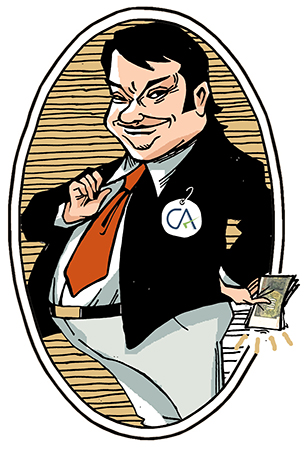
Illustration by Farzana Cooper
His technical knowledge was barely adequate but his networking was par excellence. He was a great raconteur of rib tickling funny tales, liberally interspersed with bawdy and colorful abuse. Virtually egoless, he would pretend to be a buffoon. Self deprecating humor was his weapon to disarm hostile tax officers. Jolly good Parsi fellow. So funny, so humble, so generous, so different from the other aggressive tax practitioners and chartered accountants. Not the type who would lay a trap to get an errant officer nabbed. He was family. To demonstrate that he had no guile or cunning, he would himself draw the attention of the officer to the weakness of his client’s case. This tactic had two advantages — the assessing officer’s attention would be diverted from the bigger ghotala (fudged numbers) in the return and, secondly, he would be able to extricate a larger amount from his client ("These days, people are becoming cleverer and their demands are going up,” he would inform his client). Of course, a substantial part of the amount was pocketed. "Never show mercy to the rich, loot them when the opportunity presents; otherwise you will die a pauper like my poor father,” he said.
He was innovative too. One of his client’s father and mother died within seven months. Under the then draconian Estate Duty Act, death duty rates were expropriatory (on Rs 20 lakhs and above, duty was 85%!). However, if a spouse died within six months, on the second death, there was a quick succession relief of 50%. Those days there were no computers and the death certificate issued by the Bombay Parsi Punchayet (BPP) was perfectly acceptable. His client was narrowly missing this relief in duty, his mother having died one month too late. One evening, the accountant dropped in at the Towers of Silence office of the BPP which had issued the death certificate. The aggarbatti (incense stick) lit by his silly client near his mother’s photo had made a hole in the death certificate, unfortunately exactly near the date of death; would the kind clerk write out a fresh certificate? "No need to look at your counterfoil book, dikra, she died on 26th June.” "But Uncle,” said the clerk, "it looks like July, doesn’t it?” "June, my boy, June I say,” and he pressed 10 hundred rupee notes. The clerk was tearful with joy. "No need to use that rubber stamp saying `Duplicate,’ dear.” Armed with the new death certificate, he then spoke to his client. "If I manage to get 50% off on your mother’s estate duty, then 10% is mine,” he told the client, who agreed, thinking it was impossible.
He married a rather dull and stout lady and proudly informed his friends that his wife was fat alright but so was her bank balance. He remained faithful though to his longtime Anglo-Indian girlfriend whom he took on long rides to Khopoli to have biryani. He wormed his way through to be appointed his father-in-law’s rent collector. Those days taking pughdi (amount given for transferring tenancy) from tenants was illegal, hence all such transactions were in cash. This became a good source to supplement his income.
He selected his clients with care. Mostly Parsi, mostly old, mostly gullible, mostly trusting. The occasional dodgy businessman who wanted his fudged accounts signed off. He would send a couple of his articled clerks to mechanically do an audit, while he would have a sumptuous lunch with the client, washed down with gin and lime. "Sorab, brother, your trial balance does not tally.” Sorab would smile and reply that it never tallies and that’s why he has appointed him as the auditor. "I will lose my certificate of practice one day but I like you too much, brother; so I will sign off.” Those were wonderful days, he would reminisce later in his old age, no bloody computers, no tax audit, no auditor’s liability, no prevention of corruption laws. "Wild West, darling, Wild West,” he guffawed in his jolly manner.
When he required some serious money, like to buy a flat for his daughter, Sorab and a couple of his naughty clients would be raided. They would wonder as to how the department had such precise information on their gadbad ghotala. Like a knight in shining armor, he would then swing into action. "Everything settled, brother, I know it is costly, but now at least you can sleep peacefully.” Sorab would tell Rustom and Rustom became his client. All very low profile, darling. Just one assistant from Kerala staying in Nalla Sopara. Very convenient to store all uncomfortable documents and cash.
Rustom too was raided and informed that his case was getting messier. Luckily, the officer was a gourmet and enjoyed his food and drinks. The accountant would land up at Rustom’s farm house in Karjat with the officer, his wife and their twins carrying cricket bats. While their parents and the accountant enjoyed Blue Label and caviar, the brats surveyed the old farm house containing some rare artefacts from Burma including some tall antique vases. One of the boys swung the bat and a vase was smashed. The accountant laughingly consoled the scared twins by telling them that they could break all the vases, so long as their father passed the necessary orders in Rustom’s case. The officer struck a genuine friendship with Rustom and a few years later, after a peg or two, told Rustom that the accountant himself used to provide the information to the department about his clients and collect the informer’s reward through his assistant.
When accosted by his furious clients including one Irani bakery owner who threatened to have his hands chopped, he theatrically placed his right hand on the Khordeh Avesta and swore on his only daughter that he was innocent. Not fully convinced, his clients gradually took away their files. He began to dabble in stocks to pass time. Initially, his penny stocks did very well.
Then within a span of six months, his assistant from Nalla Sopara vanished with the documents and cash. His girlfriend joined the Osho ashram and migrated to America. His daughter, whom he worshipped, succumbed to a botched up caesarean surgery. The stock market collapsed. Severe sciatica left him howling in pain. Since Blue Label was out of question, Diplomat whiskey became his support system. There was none to recount all those funny tales about altered death certificates. As the shadows began to lengthen, he was asked that if there was a second opportunity, would he have done things differently? "Look dikra,” he whispered in a hoarse voice, "ultimately my trial balance did not tally and my balance sheet looks ugly, and like my old man, I too am dying nearly a pauper, but given a second chance, I will do things exactly the same way. That kick I got in fooling some of the sharpest minds who thought that I was a foolish old bawaji with a crazy sense of humor. Brother, it was real fun.”
Berjis M. Desai is a lawyer in private practice and a part-time writer. He considers himself an unsuccessful community activist.
◆ ◆ ◆
From the archive