
Events & Personalities
Remembering Shiavax
"What a mark he left behind on the Indian art scene,” said art historian Dr Pheroza Godrej about veteran artist Shiavax Chavda (1914-1990). She was speaking at the opening of the exhibition "The dancing line: Revisiting Shiavax Chavda,” at the Jehangir Art Gallery on October 24, 2017. Recalling that she first encountered the veteran artist’s works nearly five decades ago in October 1971, Godrej said that she was struck by his gentle smile and his brooding eyes. Calling the show "almost a retrospective” of Chavda’s works, Godrej reminisced about the artist’s attraction to other art forms, drawing the audience’s attention to the pencil drawings of ballerinas that were on display. She said she got an opportunity to "reflect deeply” on Chavda’s works when she curated the exhibition "No Parsi is an island” in 2016. Hoping that some parts of the current exhibition would travel to other places in India, Godrej thanked the artist’s family members: son Pervez, daughter Jeroo and daughter-in-law Feroza for "looking after his collection... so many memories...”
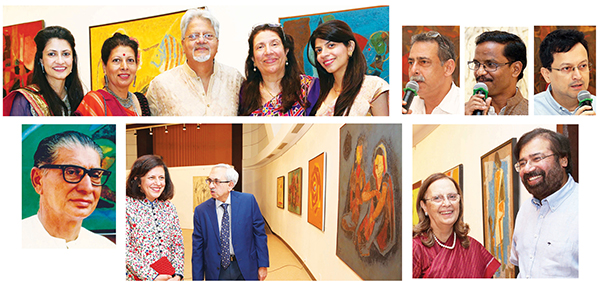
Clockwise from above, left: Artist Shiavax Chavda whose work has been preserved by family members Carina,
Jeroo, Pervez, Feroza and Sanaya; speakers Dadiba Pundole, Prof Vishwanath Sabale and Ranjit Hoskote;
admiring the works — Harsh Goenka with Dr Pheroza Godrej; Nadir and Rati Godrej
Art critic and curator Ranjit Hoskote too lauded the Chavda family’s custodianship of his legacy. "There is a certain degree of public amnesia about the works of artists of Chavda’s generation... It is sad to see the works of certain artists who slipped away before the art boom (of the 1990s) are not well known,” he rued. Hoskote exhorted the audience to admire the "invisible works,” as he described the sketches and line drawings that were on display and hoped that would provide viewers with what he termed a new journey. "More such gestures of remembrances are required,” he said.
To the chairman of the managing committee of the Gallery Adi Jehangir, Chavda’s was a name he had heard since his childhood. "How come Chavda does not have as big a reputation as (French artist Edgar) Degas (specially known for his depiction of dancers)?” he mused. According to gallerist Dadiba Pundole, Chavda belonged to a generation when there were few galleries. Lauding the technical excellence in Chavda’s paintings, he mentioned that "revisiting the forgotten artists” that Hoskote had spoken about "is what should happen more and more.” Dean of Sir J. J. School of Art Prof Vishwanath Sabale said as a student he and his colleagues would copy his paintings. "The works of artists of Chavda’s generation look fresh even now on account of their sound techniques,” he told the audience.
Writing the foreword in the exhibition catalog "Leaping into the light,” with portions reproduced from her article in Parsiana ("Artist of the dancing line,” September 21, 2016), art historian Geeta Doctor quotes the artist: "There is to me nothing throbbing with life, in a lightening release of energy as it were, as a serpent. I also feel the serpent is an ingrained symbol of Indian thought, religion and philosophy.” According to Doctor, "at the very heart of the multitudinous drawings and formal paintings of Chavda is the impulse to record life in all its throbbing variety as he found it around him.”
◆ ◆ ◆
From the archive