
Events & Personalities
Priests differ on Metro
Three high priests are opposed to the proposed 33 km Colaba-SEEPZ Metro line being constructed by the Mumbai Metro Rail Corporation Limited (MMRCL) and have sought its realignment. While one is "fully satisfied,” with the project, and the other reportedly approves, Dasturs (Dr) Kaikhusroo JamaspAsa, Kaikhushroo Meherjirana and Cyrus Dastur have sought the realignment of tunnels, fearing damage to Hormasji Bomanji Wadia Atash Behram at Princess Street and the Zarthoshti Anjuman Atash Behram at Dhobi Talao. They have also voiced fears that the Bhikha Behram Well at Fountain may run dry (see "Metro moves,” Parsiana, November 7, 2017).
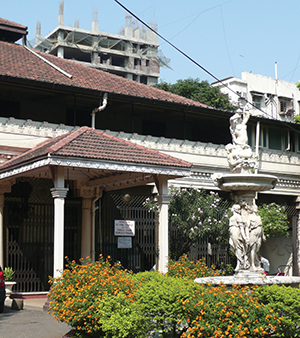
The H. B. Wadia Atash Behram Photo: Jasmine D. Driver
In a widely reported move, Dasturs (Dr) Firoze Kotwal and Khurshed Dastoor met Maharashtra chief minister Devendra Fadnavis on November 9, 2017. Chairman of the Kala Ghoda Association Maneck Davar was present at the meeting, along with president of the city’s Bharatiya Janata Party unit Ashish Shelar, managing director Ashwini Bhide and director (projects) of MMRCL, S. K. Gupta. Davar informed Parsiana on November 10 that "the chief minister assured the Dasturs that he personally was concerned about the news reports and has spoken to MMRCL officials to ascertain whether there would be any damage to the structures of the two Atash Behrams.” Davar noted that Fadnavis said that "the Atash Behrams, apart from being important places of worship for the community, were part of the heritage of the city and it was important to ensure that no harm came to them.”
The chief minister welcomed Kotwal’s statement that the Parsis were responsible for the development of Bombay and that it was not their purpose to come in the way of any development for the benefit of the city of Bombay and its people. Fadnavis "also instructed MMRCL officials to provide an assurance to the community through Kotwal and Dastoor on the safety of the structures, that the wells of the Atash Behram would not be disturbed and that the tunnel, which was 60 ft below the ground, would not violate the sanctum sanctorum of the Atash Behrams.” A written assurance from MMRCL was received on November 10. The chief minister and MMRCL officials also assured that there will be constant monitoring of both the structures and the wells, if necessary, by Parsi engineers and architects, according to Davar.
Dastoor had earlier stated the tunnel alignment does not come in the way of the sanctum sanctorum, according to news reports. The Daily News and Analysis (DNA) of November 2, quoting a press release from the MMRCL said that "Dastoor... visited the site office of MMRCL... with Maneck Davar... was fully satisfied.” Dastoor told DNA that he "invited Kotwal to come along, but he refused... I explained everything to him and he... said he was... satisfied.” The high priest told mid-day (November 7) that he had "studied everything and was satisfied with (MMRCL’s) explanations. Reacting to criticism voiced against this stance, Dastoor shot back, "Because of your (the community and priests’) carelessness and laziness, you are trying to put the blame on me... Nobody took any objection or interest in it since 2015, and now, suddenly, when everything is done, people are objecting to it. It is not a paani ka (water) pipeline that you can just turn around... I am a very pragmatic person and know that my conscience is clear.”
Senior lawyer and trustee of the Anjuman Atash Behram and Bhikha Behram Well Burjor Antia was quoted in the DNA of November 8 that the authorities have given them assurances in writing that there would not be a problem to the water or the water table of the Well. He said that the Anjuman Atash Behram trust is yet to "hear or get any assurance in writing for the temple.”
Kotwal and JamaspAsa had written to Prime Minister Narendra Modi on October 21, asking that the Metro route alignment should be reconsidered. "Consecration of an atash behram... is an elaborate and complex process, which takes over a year of teams of high-skilled priests to consecrate and enthrone the sacred fire,” they said. A letter dated October 29 from Meherjirana, also to the Prime Minister pointed out that "an Atash Behram is a composite whole, not just the consecrated fire but also includes the whole edifice in which he is housed, along with (its) circuits....” Surat high priest Dastur wrote an open letter on November 1 stating that the project can have adverse ("khubajj nuksaankarak”) effects. "All communities worship fire,” he said, hence the project can affect members of other communities too, he claimed.
"If the route is not beneath the sanctum sanctorum, then I don’t think there is a problem,” activist Dr Viraf Kapadia told the DNA of November 2, adding that "there should have been unity among high priests in this issue.”
Bombay Parsi Punchayet (BPP) chairman Yazdi Desai had earlier told the mid-day (October 28) that "We can’t take on the cause of the entire road (where the Atash Behrams stand); that is beyond our scope... The BPP’s first priority is to save the sanctum.”
◆ ◆ ◆
From the archive