
Events & Personalities
Parsis and the Gaekwads
More than 1,000 Parsis served as officers in the erstwhile Baroda state in a span of 300 years, according to a news item in the Gujarati daily Sandesh dated August 17, 2016 sent to Parsiana by Jeetendrasingh Gaekwad (who prefers to be addressed as ‘Himmat Bahadur’), great-grand-nephew of Maharaja Sayajirao Gaekwad III of Baroda who ruled from 1875 to 1939. Parsis were prominent in the civic, health, police and education fields, states the report.
"At the start of Sayajirao’s rule, Dadabhai Naoroji (then the Dewan of the state) had declared that the Parsi community will remain loyal to the rulers,” notes the article. Each of the nine councils of ministers constituted under Sayajirao’s rule had representation from the Parsi community, based on Naoroji’s commitments, according to Jeetendrasingh. He further mentions that members of the royal household visited agiaries to greet community members on their festival days. The report commends the role of Parsis in "strengthening the economy of Baroda state,” naming individuals such as Faramji Seth and Kawasji Contractor and firms such as Wadia and Company, Cama and Sons and Deboo and Brothers.
"At the start of Sayajirao’s rule, Dadabhai Naoroji (then the Dewan of the state) had declared that the Parsi community will remain loyal to the rulers,” notes the article. Each of the nine councils of ministers constituted under Sayajirao’s rule had representation from the Parsi community, based on Naoroji’s commitments, according to Jeetendrasingh. He further mentions that members of the royal household visited agiaries to greet community members on their festival days. The report commends the role of Parsis in "strengthening the economy of Baroda state,” naming individuals such as Faramji Seth and Kawasji Contractor and firms such as Wadia and Company, Cama and Sons and Deboo and Brothers.
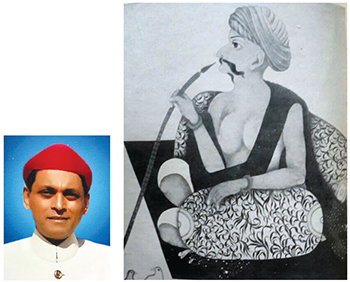
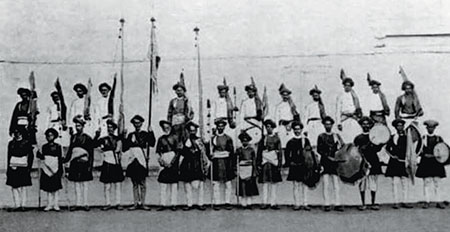
(Clockwise, from top): Jeetendrasingh Gaekwad; Pilajirao Gaekwad; Bawaji ni paltan
In the year 1700, the Parsis of Navsari were harassed by Muslim invaders, continues the report. A complaint was lodged with Pilajirao Gaekwad at Songadh who was "invited (by the Parsis) to establish Maratha rule.”
In a telephonic interview with Parsiana on August 22, 2016, Jeetendrasingh stated that Pilajirao Gaekwad, who ruled from 1721 to 1732, had taken upon himself the responsibility of defending the Parsi holy fires in his realm by establishing a Bawaji ni paltan (Parsi platoon). Contingents of 200 members of the force were located in each of the towns of Bulsar, Udvada, Sanjan and Navsari for the protection of the sacred fires during turbulent times. Vansda, he said, had a separate contingent, it being ruled by a separate royal house. The officers of the 800-strong force were mostly Parsis or Iranis, while the soldiers were drawn from the Maratha or Gujarati communities. The historian-cum-heritage revivalist reveals that the brigade was disbanded in 1952, when it was absorbed into the Indian Army.
"My fire cannot be orphaned,” is a quote ascribed to Damajirao Gaekwad who ruled from 1732 to 1768, when asked to spare troops for the Third Battle of Panipat where the Maratha Empire encountered Afghan troops in 1761. Jeetendrasingh reveals that Damajirao sent 600 men from the Parsi Brigade to take part in the battle in the northern city, retaining 200 to continue to guard the holy fires in the realm.
Jeetendrasingh reveals that he has had a deep interest in the history of the association between Parsis and the house of the Gaekwads "since he was a toddler.” He names Dr Nawaz Mody, former head of the department of civics and politics, Bombay University as his "torch bearer” and mentions that his interest in Parsi history deepened after reading Enduring Legacy, Parsis of the 20th Century edited by her.
Stating that in the house of Gaekwads, "even in this democracy, we still observe the tenets of Parsipanu: humata, hukhta, hvarashta,” he signs off with "Yazdaan Panahbad (may God protect you).”
◆ ◆ ◆
From the archive