
Readers' Forum
US anthem: Parsi connect
In the early 18th century, many British ships were built in India because the timber required was available in abundance in our country. Most, if not all these ships were built by the Wadia family of Surat who later shifted base to Bombay. For their shipbuilding ability they were given the title of "Master Builders” by Britain.
A large number of the battleships built by the Wadia family participated in sea battles, and notable amongst them was HMS Trincomalee (see "Ship ahoy,” Business, Parsiana, September 7, 2015). Built in 1817 at the Bombay Dock, she participated in battles against the Spanish Armada and also had the privilege of flying Lord Nelson’s flag. Later she was christened TS Foudroyant and used as a cadets training ship till as late as 1986. She was refurbished and renamed Trincomalee in 1992 and is now docked at Hartlepool, UK. This ship has the rare distinction of being the oldest warship afloat in the world, according to Wikipedia.
A large number of the battleships built by the Wadia family participated in sea battles, and notable amongst them was HMS Trincomalee (see "Ship ahoy,” Business, Parsiana, September 7, 2015). Built in 1817 at the Bombay Dock, she participated in battles against the Spanish Armada and also had the privilege of flying Lord Nelson’s flag. Later she was christened TS Foudroyant and used as a cadets training ship till as late as 1986. She was refurbished and renamed Trincomalee in 1992 and is now docked at Hartlepool, UK. This ship has the rare distinction of being the oldest warship afloat in the world, according to Wikipedia.
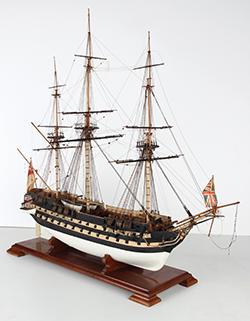
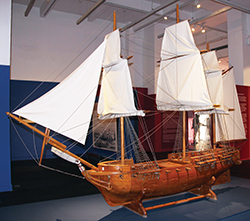
Models of the HMS Trincomalee at The Everlasting Flame, Delhi (right) and
HMS Minden at Prince of Wales Museum, Bombay Photos: Jasmine D. Driver
Amongst the many ships built by the Master Builders was HMS Minden, a 74-gun frigate built in 1810 which was the first British ship-of-the line (warship) built outside Britian. She was also the first ship to be launched from the Duncan Dock, which is still in use by the Indian Navy at the Naval Dockyard in Bombay. The Minden saw active service around the world, including the battle of 1812 between Britain and the USA, a two-year war that ended with the boundaries being established between the US and Canada. In this battle, HMS Minden was involved in the bombardment of Fort McHenry in Baltimore harbor in September 1814.
Just prior to the commencement of the attack, two Americans, Francis Scott Key and John Stuart Skinner had boarded the vessel to carry out negotiations with the ship’s captain. For security reasons they were detained on board until the attack was over. The battle was fierce and it seemed that the Fort would fall but when morning came the red, white and blue flag was still flying. It was this sight which moved Key to write the first few verses of his poem Defence of Fort McHenry on board the HMS Minden. He completed the rest of the poem on land and it became one of the most popular patriotic songs. In 1931 it was declared the country’s national anthem, The Star Spangled Banner.
The next time you hear The Star Spangled Banner playing, remember the American national anthem was inspired and written on board the HMS Minden which was made in India by a Zoroastrian family. Cmde MEDIOMA BHADA (Retd)
mrbhada@gmail.com
◆ ◆ ◆
From the archive