
The dar-e-mehr dream
While around 600 Zoroastrians attended the inauguration of the Dar-e-Mehr in New York nearly 1,500 viewers from 32 countries witnessed the ceremony online
"We had to put buckets in every room” when it snowed or rained, Shirin Khosravi recalled.
"We kept on doing patchwork repairs,” Astad Clubwala said.
After last-ditch efforts to fix the roof, the trustees of the Arbab Rustam Guiv Dar-e-Mehr looked for estimates for replacing it. The numbers that came back were daunting.
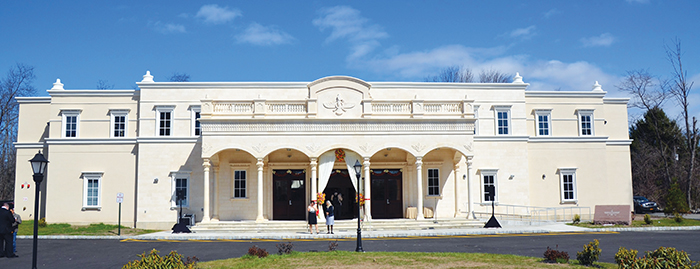
Frontage of the Dar-e-Mehr Photo: Urmez Davar
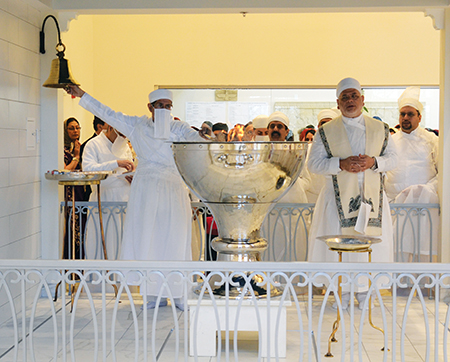
Dastoor and others look on Photo: Mahafreen H. Mistry
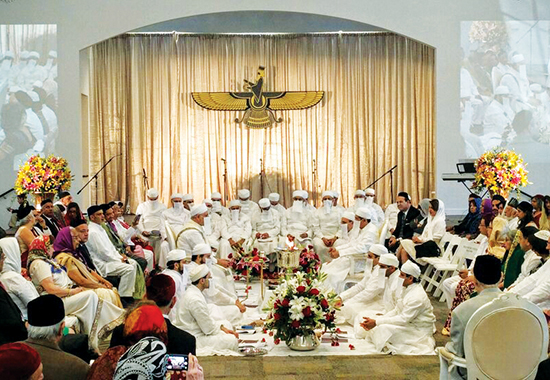
Jashan in progress Photo: Arzan Wadia
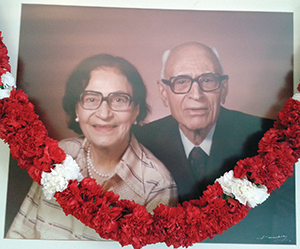
Garlanded frame of Morvarid and Arbab Rustam Guiv Photo: Porus Cooper
"The price came in in the $200,000 to $300,000 range. At that point it was like putting good money after bad,” said Clubwala, president of the Zoroastrian Association of Greater New York (ZAGNY), which along with the Iranian Zoroastrian Association led by Khosravi shared the Dar-e-Mehr.
It was time to build a new one, he and others concluded. Moreover, the community had grown and the building was proving to be inadequate and adding an extension was found to be nearly as costly as constructing a new building.
Two challenges had to be overcome — fund-raising and qualms among the community about whether it was possible to raise the $4.6 million needed.
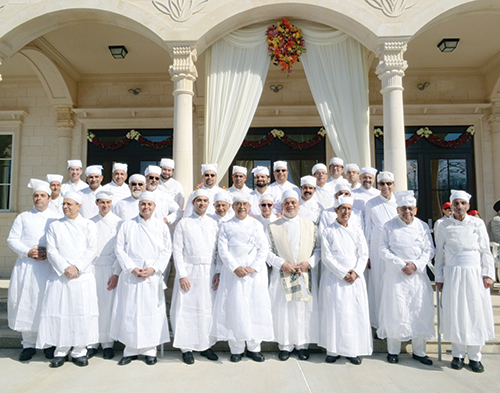
And that’s how a leaking roof became the foundation of the expansive new edifice that was inaugurated on March 26, 2016 in the presence of Udvada Vada Dastur Khurshed Dastoor, a panoply of nearly 30 mobeds from all over North America, and about 600 other Zarathushtis, many of the women resplendent in colorful garas and saris, the men in pristine daglis.
Afterward, during the six-hour program, a few would be singled out for honors:
Edul Daver, 71, the retired chief executive of a metallurgical firm who brought to the project the team-building skills he had honed in leading a corporate buyout and management group. (Many described him as the project’s "visionary.”)
Farrokh Patel, 75, the founder of a manufacturing company who brought a get-the-job-done attitude as he supervised the construction and was a prolific fund-raiser. (Clubwala called him "the rock.”)
Dinyar Wadia, 75, whose high-profile architectural shop designed the Dar-e-Mehr (an initial inspiration for the façade’s design came from an image he had seen on an old picture postcard of the dar-e-mehr in Yazd, Iran).
Khosravi, director of systems analysis at a top customer relationship management firm, who was lauded for being the glue that had helped bind the diverse community of Parsi Zarathushtis and Iranian Zarathushtis in the years since a long-ago disagreement. ("From the beginning we were all on the same page,” she said.)
The new structure, its columned façade evoking traditional agiary fronts familiar to Zarathushtis, sits on the very site of the old center in suburban Pomona, about 40 miles north of New York City. It continues to be named after Arbab Rustam Guiv, the benefactor from Iran who had enabled the New York Zarathushti community to acquire its very first center in the 1970s in New Rochelle.
"It gives me pride and joy to open this place for the people of America,” Dastoor told the gathering, noting the special relationship that he said has developed between the Iranshah and members of the ZAGNY community who have "year after year given munificent donations to help the mobeds of Udvada.”
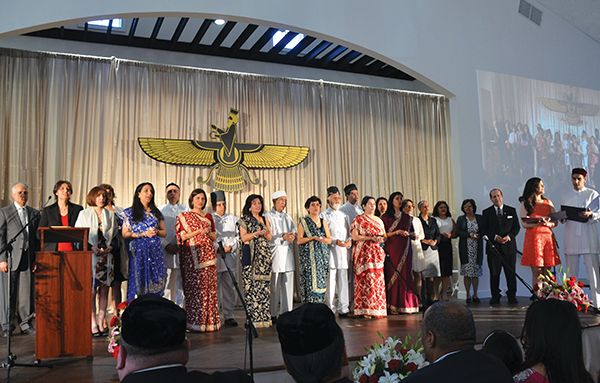
Choral group
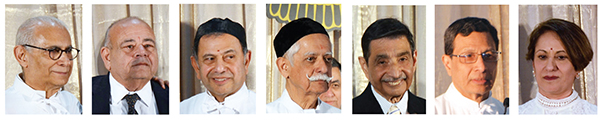
Above (from left) Dinyar Wadia, Farrokh Patel, Edul Daver, Framroze Patel, Lovji Cama, Astad Clubwala, Shirin Khosravi
Photos: ZAGNY website
On behalf of the Samast Udvada Anjuman, he came bearing tokens of gratitude for the New York, New Jersey and Connecticut Zarathushtis who will be using the Dar-e-Mehr: a "Guraj” and silver torans.
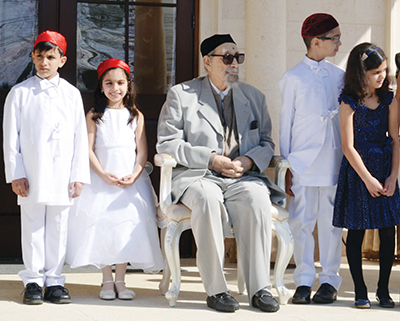
Earlier, the crowd heard from someone who for decades has been an icon in their midst, Prof Kaikhosrov D. Irani, who cut a large red ribbon to ceremonially open the center. The emeritus professor of philosophy at City College of New York is in fragile health as he nears his 93rd birthday and had to be helped on and off the podium, but his brief remarks left no doubt that his mind remains as sharp as when he regularly expounded on topics related to Zarathushti life and beliefs.
Irani recalled how 44 years ago, when a fellow New York Zarathushti, Erach Munshi — another stalwart of the community who recently passed away — summoned him and others to discuss the idea of forming an association, "eight people showed up at that first meeting.”
"Look at us now,” he said to cheers, gesturing toward the hundreds gathered in front of him at the steps of the Dar-e-Mehr. Then he proceeded to recite from the Ahunavaiti Gatha, citing the ninth verse, third chapter: "May we be like those who bring the world to perfection.”
And then, in the great hall of the Dar-e-Mehr Dastoor led the multitude of mobeds in a jashan that was live-streamed on the Internet. (Close to 1,500 viewers in 32 countries watched the proceedings on average for two hours during the six hours streamed, said the organizers.) The mobeds then proceeded to the prayer hall and kebla where New York’s longtime senior mobed, Ervad Pervez Patel, performed a boi ceremony, praying the Atash Nyaish and Doa Tandorasti. The hundreds in attendance then lined up at the kebla to pay their respects.
With that, New York, which had established North America’s first dar-e-mehr, came also to have the newest.
"It is a real dream come true,” said Lovji Cama, a founding member of ZAGNY and coordinator of its religious instruction, as he contemplated the multiple new classrooms and spacious other facilities now available to the children of the community. He corrected himself in the next breath. "It is actually better than I would have dreamt,” he said.
A week after the inauguration, the children of ZAGNY would assemble for their first religion classes at the new facility and "it was a different environment,” said Pervez Patel, who along with his daughter Avan teaches pre-navjote children.
"We provided nice seats and desks for the children and there was room even for the parents to be present so they could watch what was going on,” he said, a far cry from the makeshift spaces they used to inhabit.
In place of the 6,000 sq ft former Jewish community center with the troublesome roof that the Zarathushti community acquired in 2001, stands its shiny 22,000 sq ft replacement. Where the old building evoked Jewish themes such as menorahs, the façade of the new one was designed to evoke elements of the dar-e-mehr in Yazd and the atash behram in Navsari.
Like a new father chronicling the growth of his child, Farrokh Patel, who supervised the construction from start to finish, kept a visual diary of its progress. Patel is the founder of a New Jersey company that fabricates swimming pool liners and is ranked among the 100 largest Indian-owned private companies in the United States. His years in business appear to have imbued him with a gruff, no-nonsense manner. But he betrayed a touch of emotion as he showed the picture book to a visitor.
Frame by frame, the structure rises in the book: First, the tire tracks left by construction equipment in freshly turned up soil. Then the burying of giant drainage pipes. Next, the laying of the plastic vapor barrier protecting the floor. After that, a steel skeleton takes shape. Finally, the finished building appears, looming over a landscaped parking lot with vintage street lights lining the driveway.
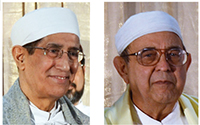
Ervads Pervez Patel (left) and Noshir Hormuzdiar
"It was about three or four years in the making,” Patel said in an interview.
Those years included fund-raising at a furious clip, beginning with a core group of 16 families, banded together as "the New Dar-e-Mehr Initiative,” who included Patel and Daver, the man generally credited with being the spark plug of the effort.
It was an admonition from Daver at the 2010 annual general meeting (AGM)of the Dar-e-Mehr Zoroastrian Temple (DMZT) board that became a rallying cry, Clubwala and others said.
Two years before, with community attendance at events growing and the old Dar-e-Mehr feeling cramped, the trustees had contemplated having a new building. But that was during the depths of the great recession, and the idea never got off the ground.
"The consensus was, the climate for fund-raising was bad,” Clubwala said.
Then at the Dar-e-Mehr board’s 2010 AGM, Daver asked whatever had become of the idea of constructing a new building.
Told that the time still didn’t seem right, "he said there never will be the perfect time to start,” Clubwala said.
That seemed to galvanize those present.
Daver said he told the group that with every delay construction costs were going to go up.
They threw the ball back to him.
"They asked me if I had a plan, and said I should go ahead,” Daver said.
He and a group of like-minded individuals — the 16 families — met and decided to incorporate themselves and pitch in with seed money and pay for the initial planning, design and permits. The price of admission to the New Dar-e-Mehr Initiative LLC was set at a minimum of $20,000 each, or $5,000 for young adults. The risk would be all theirs: If the project turned out to be infeasible, they would not be reimbursed.
Eventually, 17 donors would account for $2.9 million — more than 60% of the original fund-raising target.
Daver chronicled the effort in an account titled "From Vision to Reality”:
At DMZT’s May 2011 AGM, a year later, he wrote, "the community wholeheartedly supported the project but it must be said that privately many were skeptical of us being able to raise the required funds…”
A fund-raising committee was formed and the first triumph came that August when at a Navroz dinner event, one couple, Aashish and Dinyar Devitre pledged $ 25,000 on the condition that it would be matched that very evening. In fact, $ 28,000 was immediately contributed by those present, and the Devitres raised their pledge to match that amount.
"This became our standard mode of fund-raising as we went forward,” wrote Daver.
The pace of fund-raising would ebb and flow in the months to come.
With $ 2.5 million raised, the effort seemed to flag.
"It was clear that we needed some form of motivation to build momentum and avoid a fatal blow,” he wrote.
So in September 2013, the fund-raising team decided to force the issue. It proposed to the community that construction of the new dar-e-mehr should start when the fund-raising hit $3.5 million, which was about one million dollars short of the full amount needed. The hope was this would lend urgency to potential donors.
"Some of the DMZT trustees were adamantly opposed to this plan and a major disagreement ensued.”
It was decided then to hold a referendum on the issue in December 2013. That November, at a fund-raising event, the team scored a coup — another big donation from the Devitres, this one of $100,000, that the crowd matched, along with a $100,000 contribution from Sam Bhadha and family.
Three weeks later, the community vote was 91% in favor of the construction schedule.
The roster of substantial donors includes benefactors from as far as India (the Pallonji Mistry family) and Hong Kong (the Incorporated Zoroastrian Charity Funds of Hongkong, Canton and Macau). With the fund-raising $ 400,000 short as recently as September 2015, a Houston couple, Shernaz and Feroze Bhandara, stepped in with $ 300,000, Daver said.
But while well-timed big donations were essential, Daver noted that carrying the project across the finish line were also numerous modest efforts – from bhakra and malido sales to a kids’ bake sale. It was "a grassroots effort with close to 400 donors,” according to Daver.
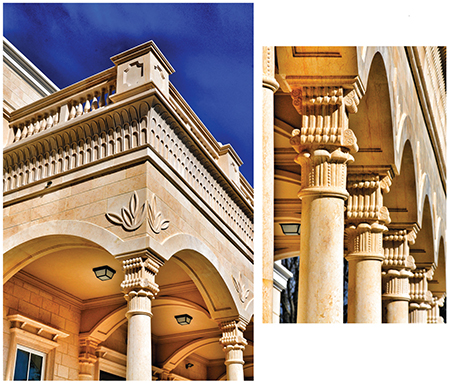
Columned frontispiece of the Dar-e-Mehr Photos: Shirin Kumana Wadia
Construction began on August 6, 2014.
During the demolition of the old Dar-e-Mehr and construction of its replacement, events were held at nearby churches, said Clubwala, 66, who works as a consultant with UNICEF.
"Our kids can now refer to a solid structure, just like a synagogue or church. … Now they have it. This structure is going to be here for 100 years or more. This will be a gift from the older generation to the younger generation,” Clubwala said.
DMZT treasurer Minu Dutia, 73, echoed that sentiment. "I hope the young people come in droves and use this place, and come often,” said Dutia, a retired research chemist for a pharmaceutical company who credited his wife Behroz, a retired accountant, for her assistance in handling the project’s finances.
He admitted to having some qualms initially about the project, but said he was comforted by the confidence of Daver’s team and by how quickly the community had raised the funds needed to acquire the previous Dar-e-Mehr building. "They have given us a beautiful, beautiful building,” Dutia said.
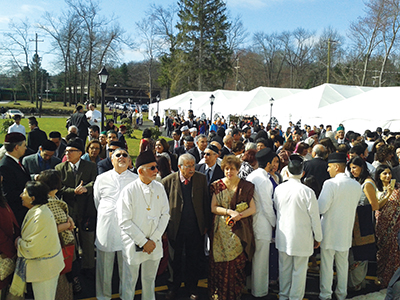
Crowd on the grounds of the Dar-e-Mehr before the inauguration Photo: Porus Cooper
And it’s a structure that the community can spiritually relate to, Khosravi and others said. "This building identifies our culture and our religion. It is not a church, and not a mosque. By looking at it you can see it is a Zoroastrian structure,” she said.
The old one, said Wadia, "did not inspire any religious fervor in our children; it looked like a dump, frankly.”
In his remarks to the crowd, Clubwala added a contemplative note, a desire that somehow the worldwide Zarathushti community find a way to heal its divisions on who is and who cannot be a Zarathushti. He had no prescriptions to offer, he said, but just a plea for a respectful dialog between the two sides.
During the many months of construction, Farrokh Patel regularly drove 85 miles from his New Jersey home to the construction site. No detail would be overlooked. The weekend before the opening, as he and others worked to make sure the building was ready for the big event, the bare wood of the staircase caught his disapproving eye. Invest in a rug to protect the polished wood, he urged Clubwala.
Then Ervad Pervez Patel, a veteran financial planner, solemnly lit the sukhad in the shiny new afarganyu in a test run and recited the Atash Nyaish.
All went well, and Farrokh Patel, head of the building committee, finally did what he had driven 85 miles to do that day — he handed over the keys to the Dar-e-Mehr to one of its trustees.
"Personally, God has given me so much. I gave back,” he said.
Porus P. Cooper is a veteran journalist in the United States.