
Environment
A clean collaboration
The recently launched Adar Poonawalla Clean City Movement invests Rs 100 crore for effective waste management in Poona
"This is a rare occasion,” said Devendra Fadnavis, chief minister of Maharashtra. "It is the first time a municipal corporation is partnering with a corporate to contribute to the mission of our Prime Minister to make India clean.” Officially launching the Adar Poonawalla Clean City Movement (APCCM) at the Serum Institute of India (SII) head office in Poona on January 7, 2016 Fadnavis thanked Poonawalla, chief executive officer of SII, and his father Dr Cyrus Poonawalla, chairman of the Poonawalla group, for investing Rs 100 crore in the Clean City initiative. "We get so much from society,” the chief minister said, "but we must also think of giving something to society in return. The Serum Institute and Poonawalla group are actually not just preaching but practicing social responsibility by giving back to society. Their initiative is laudable and inspiring.”
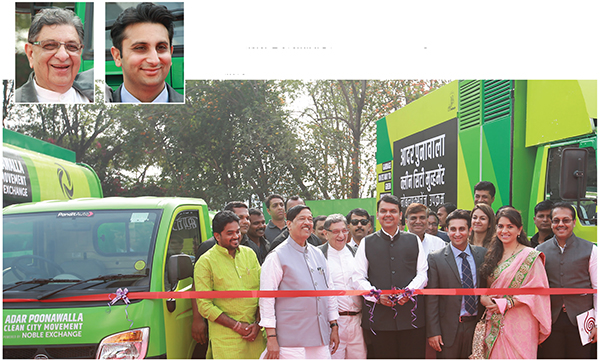
Maharashtra chief minister Devendra Fadnavis inaugurating the waste management initiative;
Inset: Dr Cyrus and Adar Poonawalla
Along with the Poona Municipal Corporation (PMC) and Noble Exchange Environment Solutions, the technology and operations partner in this movement, APCCM aims to make Poona one of the cleanest cities in India. Adar’s plan to clean up Poona began to take shape a year ago. "Everyone feels sad when they see garbage and waste lying on our streets and want to do something about it,” he said. "However, the solutions to these problems have been complex.” At current estimates, over 1,700 tonnes of waste is generated in Poona, 52 to 55% of which is wet waste. When wet waste is segregated and removed separately at source, the rest of the inorganic waste, such as plastic, metal and paper, can be scientifically processed and effectively recycled.
The APCCM will focus on supporting the PMC with infrastructure and management of solid waste, especially organic waste. This unique public-private collaboration will cover over 300 km of roads across Poona city over the next three years. With a fleet of specially designed trucks, mechanized road sweepers and thousands of litter bins, wet waste will be responsibly removed and processed at a plant in Talegaon. Once it is up and running, the impact of APCCM will be far-reaching: eco-friendly waste processing will not only free up 109 acres of landfill area but will also result in saving 542 tonnes of carbon emission. Alongside the infrastructure, APCCM will support information and outreach programs to create awareness about the importance of proper waste segregation and disposal. Together with PMC, the "clean city” message will be spread at schools, residential societies and markets.
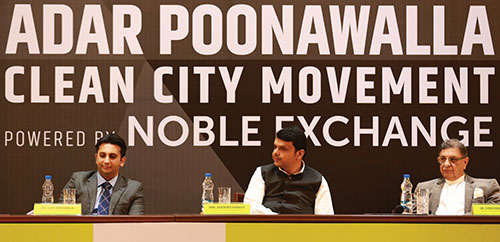
Above (from left): Adar, Fadnavis and Cyrus kicking off the project
Unscientific disposal of organic food waste creates environmental and health hazards. Such waste is generated in large volumes in urban areas but, if processed scientifically, it can be converted into renewable energy and organic manure. Adar explained: "Our aim is to make Poona one of the cleanest cities in India. We want to encourage citizens to drive this movement through active participation and appeal to them to segregate the waste at source into wet waste and dry waste.”
Poona municipal commissioner Kunal Kumar agreed that sensitizing citizens about segregation of waste at source is important. He added that Poona would set an example to the rest of India through this pioneering initiative and invited other corporations to emulate the Poonawalla group.
The long-term vision of APCCM is to ensure that more and more cities adopt this movement to make urban India cleaner, greener, healthier and happier. As Adar summed up: "With innovative technology and good management, a dramatic transformation is possible. I hope Poona can set an example to the rest of India and the world.”
◆ ◆ ◆
From the archive