
Zoroastrians Abroad
OBE for the extraordinary
"I’m fortunate to have been involved in working on the causes and prevention of musculoskeletal disorders, a major cause of ill health and disability. Throughout my career I have been privileged to work with outstanding colleagues in both academia and the clinical setting who are very much part of this achievement. I am also indebted to the Medical Research Council (MRC) for their continuous support of my research over almost three decades. I hope that I can continue to make a difference as we seek to develop and improve the health of our population,” commented Prof Cyrus Cooper who was conferred the distinction as Officer of the Order of the British Empire (OBE) at Windsor Castle, UK in March 2015. He was among the 243 OBE recipients included in the New Year Honours list for 2015 that recognizes "the achievements of a wide range of extraordinary people across the UK.” Six percent of the successful candidates come from ethnic minority communities, mentions the website gov.uk The recent honor for Cooper was brought to Parsiana’s attention by noted poet Adil Jussawalla.
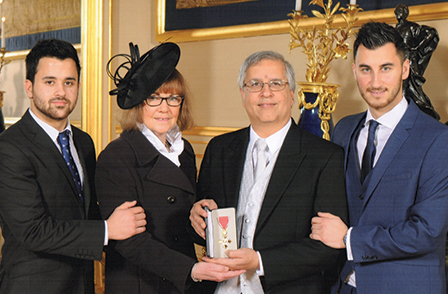
Prof Cyrus Cooper, OBE with Margaret, Philip and Charles at Windsor Castle
Director and professor of rheumatology at the MRC Lifecourse Epidemiology Unit, vice dean, Faculty of Medicine at the University of Southampton, Cooper is additionally professor of musculoskeletal science at the University of Oxford. Active in osteoporosis research for the last nearly three decades, at different points of time Cooper has served as president of the Bone Research Society of Great Britain, chaired the Committee of Scientific Advisors, International Osteoporosis Foundation and the National Osteoporosis Society. In his email responses to Parsiana Cooper revealed that as a young registrar in 1985, the then chief medical officer of the Department of Health suggested that he study the growing problem of hip fractures in older people. "The early studies in my dissertation addressed the relationship between osteoporosis and hip fracture risk, and are followed through into my current research.”
When asked to comment on osteoporosis among Parsis, Cooper responded, "Although there are few epidemiological data, it is quite clear that the problem of osteoporosis and its attendant low trauma fractures (at the hip, spine, distal forearm and many other sites) are a growing problem among the aging Parsi community.” As preventive measures he advised members of the community "to maintain adequate levels of weight-bearing physical activity; an adequate dietary calcium intake; appropriate exposure to sunlight; avoidance of tobacco; and avoidance of very heavy alcohol consumption. The most appropriate levels of physical activity are walking outdoors around 30 minutes each day, and to maintain calcium intake of around 800 mg daily one would need to ingest the equivalent of a pint (about half a liter) of milk within dairy products, beverages, yoghurt, cheese, puddings, cakes and biscuits.”
Author of over 700 peer reviewed publications and recipient of several honors including three received last year — the IOF-ESCEO (International Osteoporosis Foundation — The European Society for Clinical and Economic Aspects of Osteoporosis and Osteoarthritis) Pierre Delmas Prize, NIHR (National Institute for Health Research) Senior Investigator Award and Clinical Excellence Award Platinum — Cooper says, "My professional life has always been inspired by the vibrant and strong Zoroastrian community in the UK… We also have a strong culture of science and enterprise within the community and I have been aware of the considerable contributions made in each of these areas of life by members of our community.” Cooper earned his BA and MA degrees in medical sciences from Cambridge, MBBS from London, DM from Southampton. When he won the MRC Travelling Fellowship to the Mayo Clinic, USA he continued his research in osteoporosis. Subsequently he was made Fellow of the Royal College of Physicians, of the UK Academy of Medical Sciences and the Faculty of Public Health in London.
A member of the Zoroastrian Trust Funds of Europe as also the World Zoroastrian Organisation, he says he participates in activities as frequently as is possible. "I am proud to regard myself as a Zoroastrian and was deeply impressed by the wonderful exhibition on the religion (The Everlasting Flame: Zoroastrianism in History and Imagination) that was organized at the School of Oriental and African Studies, University of London around 18 months ago,” mentions Cooper, relating how he takes "every opportunity that I can to apprise seniors leaders in the UK of the vibrancy and achievements of the Zoroastrian faith. One occasion that I recall is that in our wedding present to Prince Charles and the Duchess of Cornwall (my wife and I were both at the wedding as I was then chairman of the board of trustees of the National Osteoporosis Society of the UK), one of the gifts that we gave them was a large color volume of the Zoroastrian religion.”
Born in Dar es Salaam, Tanzania, Cooper says he has "very fond memories of Dar es Salaam as a small provincial capital within the East African colonies of the UK, with a population of 30,000 people.” Almost four decades after the family migrated to London in 1968, they visited East Africa in 2006 when he was able to bring back memories of his old school and residential apartment but the population had by then grown to three million! "I have a strong connection to the Parsi community in East Africa as well as the North American, European and Asian diaspora to which people have migrated since the period of independence in the late 1960s.”
Cyrus and his wife Margaret, "a delightful nurse from West Cork, Ireland,” have two sons: Philip, 26, who is a teacher in London; and Charles, 24, studying medicine at the University of East Anglia, UK.
◆ ◆ ◆
From the archive