
Cover Story
Guided by the Gathas
Zoroastrians, whether by birth or choice, are more tolerant today after imbibing knowledge from ancient scriptures
History shows that the late Ardeshir Cursetji of the great Wadia family was the first Parsi to visit the United States of America in 1849. I have personally met small groups of Parsis and Iranis in Vancouver, Seattle, San Jose and Los Angeles in 1975. Both Vancouver and Los Angeles already had their associations.
It was the Islamic Revolution in Iran in 1979 that made many Iranians, including Zoroastrians, migrate to North America, Europe and Australia. At the same time, a new trend started in India, Pakistan and Bangladesh to migrate, among other countries, to North America. This increased the number of Parsis several times over. The present number of Zarathushtis in the United States is around 11,000, with and around 6,000 in Canada. This generally includes the so-called born Iranis and Parsis. The number of Zarathushtis-by-choice is good and increasing.
It was the Islamic Revolution in Iran in 1979 that made many Iranians, including Zoroastrians, migrate to North America, Europe and Australia. At the same time, a new trend started in India, Pakistan and Bangladesh to migrate, among other countries, to North America. This increased the number of Parsis several times over. The present number of Zarathushtis in the United States is around 11,000, with and around 6,000 in Canada. This generally includes the so-called born Iranis and Parsis. The number of Zarathushtis-by-choice is good and increasing.
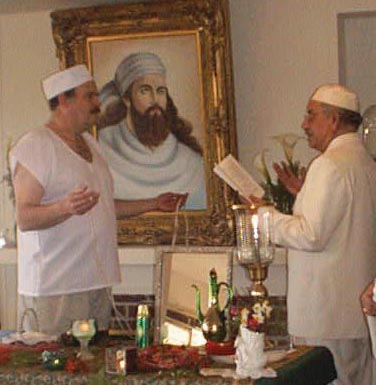
Author performing navjote of Stephen Williamson in San Jose, 2005
Photo: members.efn.org
By the time I arrived in Los Angeles in 1982, the California Zoroastrian Center was the second one, located in Westminster, Orange County. Growing into the largest Zoroastrian association outside India and Iran, it now has its branch in the San Fernando Valley, Los Angeles. In 1990 the Zarathushtrian Assembly, an association based on the universality of the Zarathushti religion and open to all who choose the religion by their considerate choice, was established. It is very active, particularly in North America, Mexico and Europe.
Meanwhile, the uproar by the traditionalists has slowly subsided. More and more tolerance and calm is appearing to give a brighter future for Daena vanghuhi Mazdayasni Zarathushtri, the good consciousness of venerating super-intellect (God) and the Zoroastrian religion.
Why the tolerance and calm? The answer lies in history since 1700+ CE when Western scholarship made the Parsis of India aware of the meaning of the Avesta and Pahlavi scriptures. Some of the Parsi scholars saw the difference between what Avesta says, Pahlavi elaborates and what they instinctively follow. The Gathas, the sublime songs of Zarathushtra, made the divine doctrine more clear by providing guidance. It is this light that is enlightening the present and future generation. The future of the Zarathushti din has become brighter because of knowledge, practice and numbers.
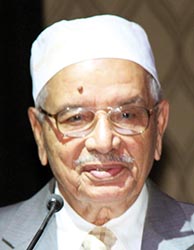 A founder director of the Zarathushtrian Assembly and a founder trustee of the Cyrus Society, Dr Ali Jafarey’s fields of specialization include Indo-Iranian history, geography, culture, religion, linguistics and literature. Author of 16 books in Persian and English on the Zarathushtrian religion and Iranian culture, Jafarey has taught at various universities and institutions in Iran and Pakistan.
◆ ◆ ◆
From the archive