
Misnaming our priests
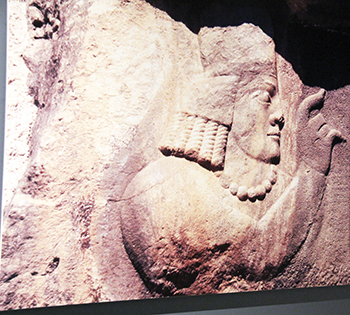
The third century Sasanian priest Kirdir
Dastur is a title given mostly to the heads of atash behrams. Termed as high priests, they look after the functioning of the institution and the religious ceremonies. The origin of the word Dastur = Dast-Bar or Dast-Gir. Dast- (Sanskrit Hast) = hand; Gir=to hold, to have to lead. He is a leader who leads you through the spiritual path, holding your hand.
So, what is the correct form to use to address our priests? They should be called Ervads.
As per my knowledge and belief, the grades for Zarathushti priests are: Aathravan-Aathravakshi (the lay priest) who has passed a navar ceremony only and tends to the dadgah fire. He can perform simple ceremonies like jashans, etc, but is not entitled to give boi; Ervad (the second grade) is one who has passed the maratab stage of priesthood. He can do basic ceremonies like jashan, navjote, marriage and give boi in a fire temple; Yozdathregar (the higher grade) is one who has undergone bareshnum and can perform higher religious ceremonies like the ijashne, vandidad, visparad, nirangdin, etc (pav mahal ni kriya); Mobed (the highest grade) is one who has attained a very saintly, exalted position in religious life. He is holder of Baatein Gyaan, one who has spiritual powers to even tune up nature — an Aabed!
BURJOR DABOO
burkhurdar@yahoo.com
At Parsiana’s request, Zoroastrian scholar Farrokh Vajifdar of London has clarified:
"Who better to confirm the real Mazdayasnian priestly promotion chain than the third century Sasanian priest Kirdir? The man who terrorized the followers of non-Mazdaean faiths in Iran and Greater (Outer) Iran under five monarchs, clearly informs us about it on his stone carved inscriptions (with his portrait alongside). The following is from Kirdir’s account of his career climb, with the Pahlavi characters alongside.
"Kirdir enters the priestly fold as junior herbad in the court of Ardashir I (224-241 CE); under the co-regency with Ardashir’s son Shahpuhr I (241-272) he rises to mobad yazdan, Shahpuhr I’s legitimate son Ohrmazd I (272-273) elevates Kirdir to Ohrmazd mobad; under Shahpuhr I’s eldest son, by a concubine, Bahram I (273-276), he is raised to dadwar/datobar, and further to ayenbed/ewenbad. Kirdir retains both titles under Bahram II (276-293). This last refers to the highest, supreme religio-juridical authority, a grandee of the realm of Iranshahr, akin in status to the Catholic supreme pontiff. It was a title never to be repeated; not even for the illustrious Weh-Shahpuhr who supervised the 21-Nask divisions under Khosro I Anushirwan (531-579).
Dadwar/Datobar became Dastwar and then Dastur. These terms refer to priests as law-makers and law-enforcers, "law" being synonymous with "religion." "Dasturji" today respectfully refers to the highest religious authority, the "ji" being applied to living Dasturs.
Other categories as Athravan [Phl. asron] existed from Avestic times. Zarathushtra is referred to as such in the Fravardin Yasht. In the Gathas he describes himself as Zaota-, the ancient libation priest, or invoker. Yaozdathregar could apply to any priest qualified to administer barashnum.
The other categories are not genuine.