
Readers' Forum
A note of optimism
What do broken down Parsi bungalows in Matheran tell us about the future of India? During long walks with my son on a recent visit, I made it a point to seek out and examine old bungalows. Typical is "Mon Repos” at Louisa Point, a roofless relic, reminiscent of long abandoned, pre-Reformation Catholic abbeys in England, which one has to approach by pushing back bushes and crawling beneath trees. A still visible sign on the gate proclaims the former owner as one "Dr (Miss) Mehra Wadia.” Another abandoned bungalow called "Rajusthan” above Hart Point has, in my opinion, the best view in Matheran. In January, when I visited this broken down bungalow again, I was both disappointed, as well as a bit happy. "Disappointed” because a thick haze of smog from the Bombay megalopolis significantly obscured the view. Several years earlier, the magnificent view seen in the accompanying photograph could still be seen. No longer. The smog now barely allows one to view the next hill.
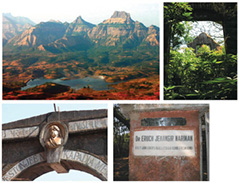 But I was also "a bit happy” because in the four or five years since I last visited this broken down bungalow, to my surprise, large trees have grown up more or less obliterating the view. Compared to the photo published here, mostly what I saw was big trees blocking the potentially grand view. Many Parsi owned Matheran bungalows have sweeping views which are now obscured by trees not cut back. (It is really unfortunate that forestry laws are applied so stringently that bungalow owners cannot, or do not, enjoy their original views.) But the same overgrown and abandoned views nevertheless also made me a "bit happy.” Why? Because they tell me that, if left alone, nature in India can spring back quickly, especially in well-watered areas like the Ghats. This is a note of optimism and hope for the future of India.
What else that seems initially sad, may have in it a note of optimism? Broken-down Parsi owned bungalows look forlorn, sad and overgrown. This reinforces the thought in the minds of most Parsis that their population and their fortunes are in decline. Yet that same decline holds a glimmer of hope for India. Most Indians do not realize this, but the birthrate in as many as a dozen Indian states (Tamil Nadu, Goa, Punjab, Kerala, West Bengal, Himachal, Maharashtra, Delhi, Sikkim, Karnataka and Jammu and Kashmir) has already fallen below replacement rates. This is principally due to better education, especially for women in these states. This means that very soon parts of India will see declining populations and lower pressure on the environment. As seen in the rapid re-growth of trees in Matheran (obscuring the views from bungalows) nature, if less pressured can stage a comeback.
Despite all the degradation and current chaos, my hope is that an educated and enlightened India, abundantly blessed by nature’s bounty and an intelligent populace, will spring into a clean, healthy and active state. And someday the unpolluted view from "Rajusthan” will once again, I fervently hope, look like the one in the photograph.
But I was also "a bit happy” because in the four or five years since I last visited this broken down bungalow, to my surprise, large trees have grown up more or less obliterating the view. Compared to the photo published here, mostly what I saw was big trees blocking the potentially grand view. Many Parsi owned Matheran bungalows have sweeping views which are now obscured by trees not cut back. (It is really unfortunate that forestry laws are applied so stringently that bungalow owners cannot, or do not, enjoy their original views.) But the same overgrown and abandoned views nevertheless also made me a "bit happy.” Why? Because they tell me that, if left alone, nature in India can spring back quickly, especially in well-watered areas like the Ghats. This is a note of optimism and hope for the future of India.What else that seems initially sad, may have in it a note of optimism? Broken-down Parsi owned bungalows look forlorn, sad and overgrown. This reinforces the thought in the minds of most Parsis that their population and their fortunes are in decline. Yet that same decline holds a glimmer of hope for India. Most Indians do not realize this, but the birthrate in as many as a dozen Indian states (Tamil Nadu, Goa, Punjab, Kerala, West Bengal, Himachal, Maharashtra, Delhi, Sikkim, Karnataka and Jammu and Kashmir) has already fallen below replacement rates. This is principally due to better education, especially for women in these states. This means that very soon parts of India will see declining populations and lower pressure on the environment. As seen in the rapid re-growth of trees in Matheran (obscuring the views from bungalows) nature, if less pressured can stage a comeback.
Despite all the degradation and current chaos, my hope is that an educated and enlightened India, abundantly blessed by nature’s bounty and an intelligent populace, will spring into a clean, healthy and active state. And someday the unpolluted view from "Rajusthan” will once again, I fervently hope, look like the one in the photograph.
Prof FAROK J. CONTRACTOR
Flemington, New Jersey, USA
Flemington, New Jersey, USA
◆ ◆ ◆
From the archive