
Readers' Forum
“On the road with Rishad”
I just read the review of my book, Hot Tea Across India ("On the road with Rishad,” Books, Parsiana, June 21, 2012) and would like to congratulate the reviewer on her keen eye in spotting the word "reign” instead of "rein.” That will be changed in the next edition.
Drass is a lovely little village sitting beyond the Himalayas. Your reviewer should make the trip there to see a signpost erected by the BRO (Border Roads Organization) stating that the temperature did indeed fall to 60 (not six) degrees centigrade below zero on January 9, 1995. Here is a photograph of the signpost which I had taken while at Drass in June 2004.
Drass is a lovely little village sitting beyond the Himalayas. Your reviewer should make the trip there to see a signpost erected by the BRO (Border Roads Organization) stating that the temperature did indeed fall to 60 (not six) degrees centigrade below zero on January 9, 1995. Here is a photograph of the signpost which I had taken while at Drass in June 2004.
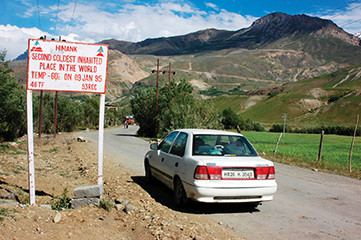
Signpost at Drass noting a record fall in temperature to -60°C
Photo: Rishaad Sam Mehta
Photo: Rishaad Sam Mehta
If the reviewer had just Googled "Drass 60 degrees below” she would have found several references to the temperature in Drass falling so low.
RISHAD SAAM MEHTA
contact@rishad.co.in
The reviewer regrets the error. The assumption was based on the reasoning that human habitation would not be possible at such low temperatures.
I read with great interest a review of the book Hot Tea Across India ("On the road with Rishad,” Books, Parsiana, June 21, 2012). My interest in this review was piqued on two counts: the author, Rishad Saam Mehta, is the son of my friend Saam Dorab Mehta who passed away recently; and second, I have been to Drass, a village on the Srinagar to Leh road, which is reputed to be the coldest continuously inhabited place in the world. There are other places that are much colder like on the South Pole or the top of Mt Everest, but nobody lives there all year round.
Drass is at an elevation of 10,990 feet and in the local language "Drass” means "hell.” Summers start in June and go on till early September, with average temperatures near 15° C (60° F) and little precipitation. From December to May Drass gets about 360 mm (14 inches) of snow. Winters are extremely harsh with average lows around -22° C (-10° F), and as low as -45° C at the height of winter, which lasts from mid-October to mid-May. The all time low recorded temperature is -58° C, so a -60° C mentioned by Mehta at Drass is distinctly possible and the reviewer seems to have erred in stating that the author may have meant "six degrees centigrade.”
Luckily, when I passed through Drass in a Mahindra Jeep in 1985, it was not that cold as otherwise the roads are not passable. But I did have to sleep with my boots on, wearing every bit of clothing that I carried, including a woolen khaki army shirt which may have been used in World War II. On my return journey on the same road I gave the shirt as bakhshish (tip) to the dak bungalow’s chowkidar.
Drass is at an elevation of 10,990 feet and in the local language "Drass” means "hell.” Summers start in June and go on till early September, with average temperatures near 15° C (60° F) and little precipitation. From December to May Drass gets about 360 mm (14 inches) of snow. Winters are extremely harsh with average lows around -22° C (-10° F), and as low as -45° C at the height of winter, which lasts from mid-October to mid-May. The all time low recorded temperature is -58° C, so a -60° C mentioned by Mehta at Drass is distinctly possible and the reviewer seems to have erred in stating that the author may have meant "six degrees centigrade.”
Luckily, when I passed through Drass in a Mahindra Jeep in 1985, it was not that cold as otherwise the roads are not passable. But I did have to sleep with my boots on, wearing every bit of clothing that I carried, including a woolen khaki army shirt which may have been used in World War II. On my return journey on the same road I gave the shirt as bakhshish (tip) to the dak bungalow’s chowkidar.
ARDESHIR B. DAMANIA
Davis, California, USA
abdamania@yahoo.com
Davis, California, USA
abdamania@yahoo.com
◆ ◆ ◆
From the archive