
Readers' Forum
The beach at Udvada
The common belief is that the name Udvada is derived from "unt-wada,” the place where grazed the camels of the Raja of Mandvi who owned a palace in Udvada in the 17th century. Yet another interpretation is that the name is of San- skrit origin, "Udan-vas,” udan meaning water and vas denoting a place. There is a reference to the town in earlier times being inundated periodically, probably with tidal water.
An octogenarian who had spent my childhood in the holy town, I remember the tidal attacks that touched the wall of the Damanwala Dispensary and the Maternity Hospital where my father was the medical officer in charge. This was in the early 1940s when some huts in the fishermen’s colony were destroyed. Sub- sequently, the sea has been advancing landward, destroying sea front proper- ties.
To control the tidal as- sault on the sacred shores of the abode of the Iranshah, the late politician Homi Taleyarkhan set up The Save Udwada Trust (SUT), sought the advice of the Central Water Power Research Station located at Khadakvasla in Poona for the design of breakwaters (sea walls) to counter the giant waves of monsoon storms and obtained financial support of the government of Gujarat. Seventy-five percent of the cost of con- struction of seven breakwaters of a total of over Rs 50 lakh in Phase I of the project (extending from Pirojsha Pallanji High School to the J. J. Dharamshala) was to be met by the government and the remaining 25 percent raised by the SUT through donations.
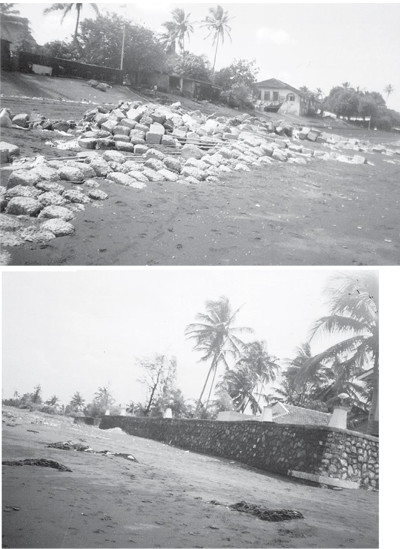
Top: View of a damaged breakwater constructed 15 years ago bottom: The same site today, the stones buried under sand with a good beach developing
Unfortunately, Taleyarkhan passed away before completion of the project but the newly appointed chairman of the Trust, Temas Pandol extended support to the co-chairman, the late Bejon Baldawala, chairperson emeritus Thrity Taleyarkhan and other trustees Burjor Antia and Vispi Dastur who continued the good work. Under Phase II of the project, Pandol got the approval of the Gujarat government to build six more breakwaters in the northern part of the shoreline from the J. J. Dharamshala up to the Gymkhana, again with 75 percent of financial contribution from the state.
Phase II introduced some innovations to counter the shortcomings of the ear- lier breakwaters. The new ones are cov- ered with nets to prevent stones and cement slabs from being dislodged by heavy tidal movements and scattered on the beach. As a result a good sandy beach has developed opposite the resi- dential bungalows along the northern shore. The southern shore, covered by Phase I, is experiencing higher tidal force during the peak of the monsoon and the breakwaters have not been completely covered by sand. However, sand is be- ing deposited on the landward side of the breakwaters, raising hopes of a good beach developing in course of time. What is most important is that not a single property has been damaged since con- struction of the breakwaters because they bear the brunt of giant waves and pre- vent the stormy sea from harming the shore.
Devotees and tourists visiting the beach feel its scenic beauty is marred by the breakwaters and the stones/concrete slabs of the sea walls that have been dislodged by heavy tides and lie scat- tered on the shore. But then any structure on the beach experiencing continuous wave action needs periodic repairs after several seasons of severe storms. Par- ticularly vulnerable to marine assault are two sites, one opposite the J. J. Dharam- shala and the other opposite the Pirojsha Pallanji High School where the break- waters are most damaged and deserve special attention.
The SUT appeals to devotees to do- nate generously to enable the Trust to carry out re- pairs on the damaged breakwaters. Cheques in favor of "The Save Udwada Trust” may be sent to Naozer B. Balda- wala, 27 Kailash Darshan, Kennedy Bridge, Nana Chowk, Bombay 400007. Donations qualify for tax exemption under Section
80G
◆ ◆ ◆
From the archive