
Books
Ritual guide
The Ceremonies of Navjote and Marriage (For Athornans, with explanation of rituals and prayers) by Ervad Asphandiar R. Dadachanji, with English translation by Ervad (Dr) Ramiyar P. Karanjia. Published in 2010 by the author, Vachaghandy Agiary, Hughes Road, Bombay 400007. Pp: 117. For free distribution.
This book, written in Gujarati along with its English translation explaining the navjote and marriage ceremonies will be of great help to Zoroastrians in general and young athornans in particular. In the present times many young athornans have not taken religious education at specialized institutions like the Dadar Athornan Institute or the M. F. Cama Athornan Institute and are not fully qualified for their initiation as navars. Due to the present education system, most of them do not know how to (or find it difficult to) read and write in the Gujarati script. For them, transliteration as well as translation in English will be of immense use.
The author, Ervad Asphandiar R. Dadachanji, panthaky of the Vachaghandy Agiary is a veteran practicing senior priest performing higher liturgical ceremonies. He was also a teacher of Avesta recital at the M. F. Cama Athornan Institute. The transliteration and translation into English by Ervad (Dr) Ramiyar P. Karanjia, principal of the Dadar Athornan Institute, and the preface by Dastur (Dr) Firoze M. Kotwal add to the value of this compact, hardbound book.
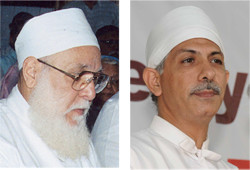
Author Ervad Asphandiar Dadachanji (left) and translator Ervad (Dr) Ramiyar Karanjia (Photo: Sarosh Daruwalla, Mazda Audio Video Lab)
While detailing the instruction for ceremonies, the author at times refers to slight differences in certain practices.
The author correctly mentions that for the nahn ceremony, the alat (religious requisites) is to be readied by the mobed who is under ritualistic discipline of khub, during which the padan is essential to maintain the sanctity of the alat. Therefore, it is also necessary that the priest retains the padan on his face while administering nahn. Further, the nirang should be given to the candidate in a ritually cleaned and dried metal cup (fuliyu), and not in a glass. Thereafter the ablution (sacred bath) during the nahn has to be administered under the corresponding baj ritual (nahvani baj).
Though there are some typographical errors, on the whole the book should find a place in every Zoroastrian house, particularly among athornan families. Dadachanji has truly served the community and earned merit of good deeds (hvrashta) by preparing this bi-lingual book for free distribution among members of the Zoroastrian community in pious memory of his mother, the late Aaimai Rustomji Dadachanji.
Dastur (Dr) Peshotan H. Mirza
◆ ◆ ◆
From the archive