
Zoroastrians Abroad
Religious response
A Roman Catholic who represents the archbishop of Cardiff at interfaith affairs, Peter Clark declared that his own religious position was enriched by his enquiries into the faith propounded by Zarathushtra. This was in the course of an interview with a Houston-based radio station arranged by the Zoroastrian Association of Houston (ZAH) Library Committee. Expressing his admiration for the Zoroastrian religion, Clark shared his experience of studying Zoroastrian tradition.
The acclaimed author of Zoroastrianism: An Introduction to an Ancient Faith, considered a definitive book on Zoroastrianism, Clark had chosen "Invisible Walls, Hidden Faces, Zoroastrian Priesthood, Ritual and Purity” as his dissertation topic for his MPhil in religious studies. Besides holding lecturing posts at Cardiff University, University of Wolverhampton and Chester College, University of Liverpool, Clark also serves as organist and choirmaster at St Peter’s Church in Cardiff.
The optimistic nature of Zoroastrianism is exemplified in its eschatology (a belief concerning death, the end of the world or ultimate destiny of all mankind), summed up Clark in the course of his lectures at the Zarathushti Heritage and Cultural Center under the auspices of the ZAH Library Committee on October 17 and 18, 2009. On Parsiana’s request Clark sent a summary of the three lectures he delivered. Attempting to demonstrate the organic nature of religions he explained that "they do not remain doctrinally static but develop often in response to the prevailing cultural, historical and even geographical conditions within which they operate.” Whilst the original vision of Zarathushtra seemed to suggest that the House of Lies would be a permanent abode for the unrighteous, a later revision indicated that all men and women would enjoy the refreshment (frashokereti) of the world.
In fact the eschatology of the Christian tradition may have its origins in Zoroastrian beliefs, conveyed Clark, citing his reasons: The Jews’ release from captivity by Cyrus led to a gradual realization of "universalism” of God and an increasing belief in afterlife. Secondly, Matthew’s Gospel dwells on the "separation of sheep and goats,” similar to the Zoroastrian concept of "bridge of the separator” to segregate the righteous from the unrighteous.
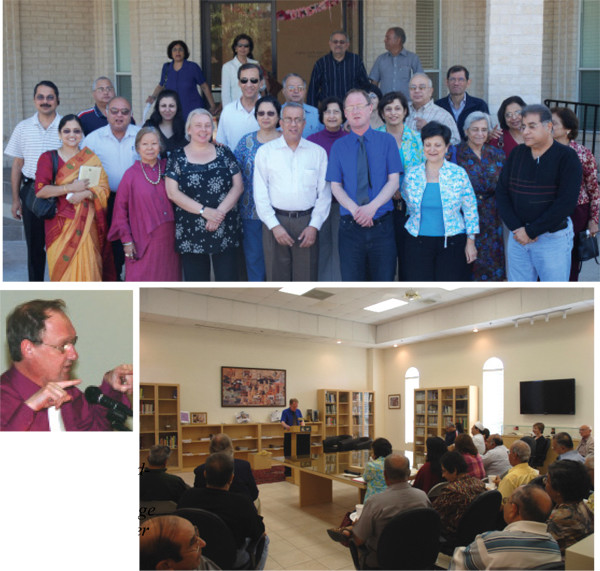
Peter Clark with members of the audience at Houston’s Zarathushti Heritage and Cultural Center
Another lecture explored rituals, particularly the Zoroastrian yasna ceremony whose purpose, explained Clark, was "to glorify Ahura Mazda and make possible a connection between the menog and getig (physical and spiritual) states. Furthermore, it is self-generative insofar as it creates (with the paragna ceremony which immediately precedes it) the very state of purity required for its efficacy.” This results in an enhancement on an intellectual as well as spiritual level, religious experience and knowledge for the practitioner and observer (the liturgy’s sponsors as also the living and departed souls).
The vexed question of whether Zoroastrianism is monotheistic or dualistic was addressed but Clark maintained that since the Prophet himself had left no definitive pronouncement on the matter and that he was seemingly more concerned with defeating evil, "it was probably better to follow his example and attend to the daily concern of trying to follow the path of Asha.” Each lecture was followed by lively discussions which "were always conducted in a cheerful manner” although at times they generated heartfelt disagreement between members of the audience or between the audience and the lecturer, reported Clark.
◆ ◆ ◆
From the archive