
Books
Powerful prayer
There is a great demand from people for the powerful prayer Atash Niyaesh, writes author Adil F. Rangoonwalla in his introductory letter to Atash Niyaesh, Translated and Explained, published in 2009. And as the original book in which he had expounded on it, Five Niyaeshes, Translated and Explained has sold out he decided to print a handy book on this Niyaesh alone, albeit with some modifications in the text and the inclusion of some new points. In the Atash Niyaesh one prays that Ahura Mazda and his great Yazad Atash give us blessings "quickly,” Rangoonwalla explains, so that we may "attain maximum religious-spiritual growth as fast as we can.”
Zoroastrians worship the natural elements, the chief one of which is fire, the "great purifier.” Considered a very efficacious prayer, the Atash Niyaesh helps people overcome difficulties, fulfill cherished desires, fight off evil and keep in contact with the spirit of fire and with Ahura Mazda. The prayer is also a beautiful portrayal of the relationship between fire and a true fire worshipper. The author takes the reader through 10 verses of the prayer, explaining their meaning and essence. The approach is knowledgeable rather than scholarly. The text is interspersed with some black and white photographs of fire temples and there is a section on references and notes at the end of the book.
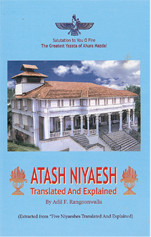
Three types of fire are worshipped in Zoroastrian fire temples — the atash behram, the atash adaran and the atash dadgah — in descending order of gradation. Rangoonwalla explains that this is based on the degree of ritual consecration invested in the respective fires. However, all forms of fire are to be regarded as sacred so, for example, one should not burn garbage or stamp out a cigarette butt.
Rangoonwalla concludes with a wish that our whole life should become a prayer for Atash: "O benefic fire, may you radiate and glow in our hearts till the time of final world-perfection, the bright, shining frashokereti.”
This book, like its predecessor, has been dedicated to Kavasji Edulji Kanga, scholar of Avesta and Pahlavi, whose works have "shone like the stars and have guided us in our religious-spiritual journey.” Rangoonwalla has thanked Dinshaw Tamboly, managing trustee of the World Zoroastrian Oganisation for his help in the making of the book as well as Homi Ranina, Bomi Hansotia and Ervad Yazdi Aibara of Sant Kookadaru Trust and Karani Agiary, and trustees of The Parsee Vegetarian Society, especially Nariman Modi for their help in distributing it to members of the community.
SHERENE VAKIL
◆ ◆ ◆
From the archive