
Zoroastrians Abroad
A career in ballet
A grounding in classical dance can spin a host of opportunities in a lifetime discovered Rashna Homji and Stephen Jefferies
"I had problems walking — my feet were turned in. My uncle, Dr Sorab Minwalla, felt ballet lessons would help. I never looked back!”
Rashna Homji Jefferies related to Parsiana the start of her seemingly destined career as a dancer that took the Karachi born girl to London’s Royal Ballet School, going on to join The Royal Ballet Company where she reached the status of lead soloist in productions like Sleeping Beauty, La Fille Mal Gardee, Concerto Pas de Deux and many more and thereafter as teacher and ballet principal at the School.
At two-and-a-half she was put into limbering classes as well, learning to do back bends and cartwheels — the beginnings of gymnastics. "I enjoyed it a lot,” she recalls and this training on the side continued with normal education at the Karachi Grammar School, that is until father Homi Homji was transferred to Bangkok as head of the social affairs division of ECAFE (Economic Commission for Asia and the Far East, a part of the United Nations Organization) and the family joined him there. He was not in favor of her wanting to go to London to join the Royal Ballet School, but "my mother Villie persuaded him, saying ‘if she doesn’t get admission there she will come back.’”
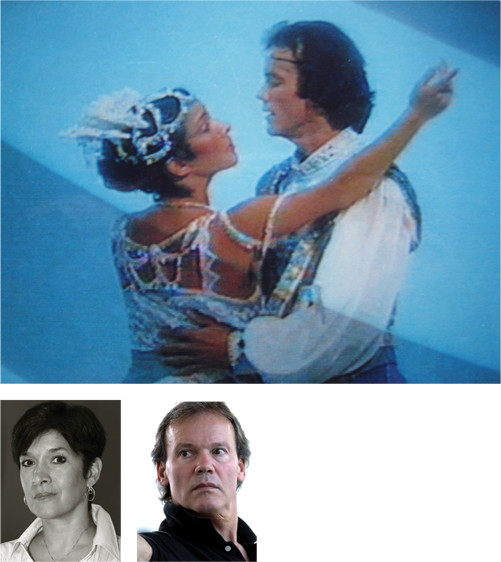
In a ballet production; Rashna Homji and Stephen Jefferies
So at age 12 Rashna left Bangkok for London where she joined the junior section of the School which functioned at White Lodge, a hunting lodge donated by the royal family. The junior section (11-16 years) still exists there and the kids complete their GCEs (General Certificate of Education) there even as she did, she tells us. It was at the senior section (16-18 years) of the School, at that time in Baron’s Court, West London, that she met fellow student and future husband, German born, Birmingham raised Stephen Jefferies. After graduating from the School both of them were accepted into the Royal Ballet Company, where he continued as lead dancer though she had to stop full-time dancing in her mid 20s because of severe knee injuries.
Taking on the much less strenuous option of freelancing, Rashna performed in ballet accompaniments to opera at the Royal Opera House like Les Africiannes where Placido Domingo was the lead singer and she the lead dancer, and for TV, appearing in such BBC TV productions such as Leda and the Swan.
After the birth of her first child, Lara, Rashna founded the Dance Directory in partnership with ex dancer (and now assistant director of the Royal Ballet) Jeanette Laurence. A theatrical agency, the Directory found jobs for dancers, choreographers and other ballet related personnel. Asked if she’d be interested in teaching at the Royal Ballet School, Rashna took on the job in 1984. A year later her son Christopher was born. In 1992 she was offered the job of ballet school administrator which entailed being "ballet principal, running auditions, whittling 1,000 seeking admission to 18 at the final count, making annual assessments — we had to produce the best dancers,” she tells us. A separate academics principal looked after the children’s normal schooling. At the end of the course they "went into a variety of careers if they couldn’t find vocational openings. They are so disciplined, they can easily go into another career,” notes Rashna adding, "Of 18, at least 12 to 15 would get a dancing job.”
Stephen who had continued dancing at the Royal Ballet was offered the directorship of the Hong Kong Ballet in 1996 and for the next 10-and-a-half years the Jefferies settled in the island city where Rashna functioned for four years as ballet mistress and lecturer in ballet at the Hong Kong Academy of Performing Arts. Stephen says he found the "company in a mess. There was no direction, no vision. We had to impose draconian measures to lift it to international standards.” The two "bad cops” instilled the discipline and standards they had imbibed and after building up the company took it touring in Europe where they earned an international reputation, note the Jefferies. In Madrid they performed to full houses, says Stephen.
They tried to give the company "an identity of its own…deliberately exploited Chinese culture and mythology, used music by Chinese composers and Chinese design professionals.” Stephen who had a lot of contacts with the ballet world choreographed a special presentation of The Last Emperor for events celebrating the change of rule in 1997 when Britain returned the colony to China. "All the TV networks put us on the map. We got offers from the US and later from Canada, Europe and mainland China. It became a classic.”
But even while they concentrated on the unique Chinese identity, the company also presented the normal repertoire of classics like Swan Lake, Sleeping Beauty and Nutcracker Suite, noted Stephen. "A very successful tour of the US and Canada with The Legend of the Great Archer was followed by Suzie Wong which was a huge success in Hong Kong. The US director of the Nancy Kwang movie was in the city and fell in love with it and filmed it. Negotiations are on for a full length movie,” says Rashna.
Madame Butterfly and Turiandot were made into ballets. The Hong Kong Ballet Company’s 30 performances a year grew to 100. "In the US we gave 25 performances in 30 days,” Rashna spoke of the grueling schedule. "By then they were all trained dancers. We had a mixed bag of 12 nationalities — Chinese, Australian, Korean, Canadian, English Japanese, Swedish, Filipino, Malaysian…Because we were a small company, my job was to identify latent talent as all the top dancers went to big companies. We had to find those who had escaped the bigger companies’ talent hunts. Our dancers were invited by Paris, Miami, Bolshoi and other (companies). Most stayed because they knew they were being developed,” Rashna describes the evolution of the troupe.
By the end of the contract period the search for originality soured. "We had got on well with the old chairman of Hong Kong Ballet Limited. The new chairman wanted us to be like a mini New York City Ballet, going back 10-and-a-half years. I couldn’t stomach it. There was no alternative but to leave,” said Stephen.
They were the first foreigners invited to open a company on mainland China. Stephen was called in as choreographer in Suzhou, a cultural center west of Shanghai. They were setting up a dinner theater and the idea was to put a dance based show into it. "We set off trying to find international dancers for Voyages…It was a very tough assignment to set up a company of 55 dancers and train them in months. (The production) was supposed to open in October 2007 but was postponed to January 2008. …It was a two-year contract but after 14 months we found a huge lack of communication,” the Jefferies relived the experience. Foreign dancers were disbanded at the end of their one-year contract. The total number of dancers came down to 29. The Jefferies opted out. "It is now A CAREER IN BALLET
continued from page 30
called S. B. Theatre and run by two Chinese who were part of our staff. They are teaching the Chinese classical ballet…”
Freelancing since April 2008 they are guest teachers with the English Ballet School. "Stephen’s rendition of the Nutcracker is still being performed by Hong Kong Ballet so we went back for it at Xmas time. I was invited to guest teach at the ballet school of the Hong Kong Company of Performing Arts,” Rashna traces later developments. In tune with their international commitments they have homes in three cities — Bangkok, Hong Kong and London.
They expect to start an agency business again but also get invitations to teach. Stephen continues to stage ballets to which he has choreography rights which is an intellectual property. "It takes three to five years to do research for a new rendition and if you are working with a composer, the music has to be just right. Also the sets. The scenario must ensure seamless progression,” explains Rashna. Stephen created 22 new full-length productions plus 13 short items in 10-and-a-half years in Hong Kong. It was "a very creative period, a very exciting time,” she notes, adding, "Some of the best ballet dancers are Chinese. They have excellent physiques.”
◆ ◆ ◆
From the archive