
Events & Personalities
Silver screen stories
With many of Bombay’s old theaters yielding to the multiplex wave, the Hindustan Times (HT), in its edition of April 27, 2008 uncovered some of the secrets and stories behind these cinema houses. Of the five cinema houses mentioned, four are Parsi owned. The New Excelsior, established in 1887, survives in its most recently refurbished avatar with orange synthetic leather couches and glossy faux wood, HT reveals.
Built by the Baliwala and Moghul families, it was then known as the Novelty where Parsi plays were frequently performed in which only male actors were allowed to play female characters. Novelty was converted into a cinema in the early 20th century. Located off Dadabhai Naoroji Road "the building was torn down and renamed Excelsior theater in 1907. And then again in 1975, when it became the New Excelsior,” the theater’s manager Hasmukh Mota informed HT. However, there are no plans to make it a multiplex. "There’s a commercial building on top, and we don’t have enough horizontal space to make it into a multi-screen theater,” Mota explained. So New Excelsior will continue to remain a single screen wonder in the multiplex milieu, HT mentions.
In its early days Novelty earned its place in history because the Lumiere Brothers chose it for the screening of their short films after the premiere at Watson’s Hotel in 1897. And in 1937, the cinema became the site of a major agitation against British rule by Muslims after the screening of The Drum, a film that vilified the Pathans and advocated the continuance of British rule in India, as per the HT report.
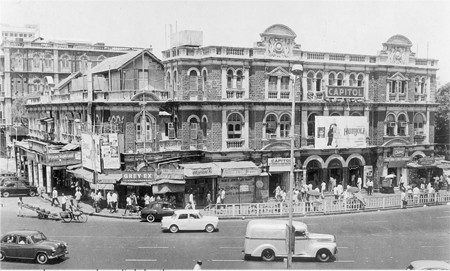
Capital cinema closed down recently due to high cost of maintenance
Capitol Cinema located opposite Victoria Terminus railway station closed down recently. When it was established in 1879 it was known as Gaiety, a Gothic playhouse meant for the entertainment of the Fort area’s upper class residents. The edifice, built by Sorabji Kuverji Nazir was an exercise in excess with a 40 x 70 ft stage and a seating capacity of 880. The backdrop scene, believed to have been monitored by the then Governor Wilson himself, featured a grand panorama of the Bombay skyline — the Rajabai Tower, the Victoria Terminus and the University buildings, writes HT. When the Sidhwa family bought it over in 1929 and turned it into a "talkies,” the seats were replaced with fine leather upholstery. A magnificent domed ceiling was added and it was renamed the Capitol.
Over the last decade Capitol, unable to bear the cost of its maintenance — approximately Rs 50,000 per month — lost much of its former glory and began to screen reruns of old Bollywood films for which no taxes need be paid, HT reveals. Today the building stands unused and lonely housing the debris of a long career — a lopsided "Now showing” board, an unmanned canteen with the prices still scrawled across it, and a gilt-edged gallery box from where rich Englishmen once watched operas.
New Royal, in the Grant Road area was built in 1912 on the site of a cemetery. The theater’s co-owner Russi Arya told HT about the area’s history: "It’s now called Pila Haus and associated with prostitution but the name comes from the word playhouse. This entire stretch has several theaters and they all came up in the 19th and 20th centuries.” New Royal had a special zenana class for women. "There had to be compartmentalized seating because the women would be in purdah and the Brahmins wouldn’t sit next to any other caste,” Arya, whose family has owned the theater for 60 years, informed HT. He can still remember the days of the hand-operated projector when the theater was nothing more than a tin shed. It finally became a concrete building in the 1940s, he recalls.
Edward Theatre, with its colonial architecture is a distinct misfit in the jumble of commercial buildings that make Kalbadevi Road. Established in 1918, the Edward was once a respected cinema house frequented by the European upper classes of the Fort area. Today a collection of slightly dubious characters hangs around outside it. Unfortunately, Edward doesn’t have enough documentation to make the city’s heritage list, bemoans HT. It was first mentioned in a land survey only in 1918, although the management has a land deed dating back to 1844, when the plot was purchased by one Bahadurji Jamshedji.
Despite its slight sordidness, Edward is a little known gem in the city’s theater scene, if only for its sheer height. Its upper balcony area, situated at a mind-boggling four-storey height, is off limits to women because "they get dizzy when they try watching the movie from that height.” According to manager Sanjay Vasawa, there are no plans to sell the theater. "The owners, the Poonawala family, are willing to keep it going even if it doesn’t make a profit, out of respect to its heritage,” Vasawa informed HT.
◆ ◆ ◆
From the archive