
Events & Personalities
Dabhoiwala’s Eden
It would be difficult for anyone passing Roshan Dabhoiwala’s bungalow with its lush garden on the sea facing Carter Road in the Bombay suburb of Bandra to imagine that until a few years ago there was a festering mountain of garbage right outside her house. In 1987 Dabhoiwala joined the one-month-old Bandra West Residents’ Association to get the area cleaned, but remained unsuccessful despite repeated complaints made to the Bombay Municipal Corporation (BMC). That’s when the determined homemaker decided to take matters into her own hands. And she has shown by living example that Bombay can be made a better place to live in if citizens become part of the cleaning up process. In a write-up sent to Parsiana, Dabhoiwala bemoans the fact that people have a NIMBY attitude to garbage… as long as it is "Not in my back yard” it doesn’t matter where it is thrown! They expect the BMC to efficiently remove the garbage while conveniently forgetting that the municipality did not create it!
A little over a decade back Dabhoiwala began to segregate the garbage in her house and created a small vermiculture pit in a corner of her garden. Having a family of 10 persons (she lives with her two sons, their wives and children, sundry dogs and three living-in domestic helpers!) the kitchen output of wet waste is about two buckets per day. This goes into the vermiculture pit along with garden waste from the compound. The dry waste is collected by the BMC’s truck.
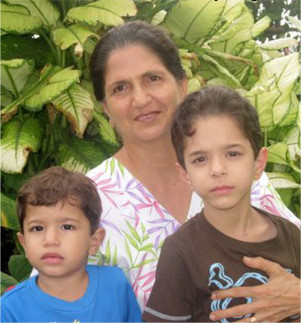
Dabhoiwala with grandsons Rohan (left) and Farhan
The vermiculture pit is very simple to start and maintain and there are many people who can help one professionally, Dabhoiwala informs. The pit consists of several layers. First comes a layer of earth, then one of sugarcane waste followed by a layer of cowdung (khat) which fosters the growth of earthworms. Next comes vermicompost soil containing a bucketful of earthworms. This is again covered with earth. At regular intervals the pit is sifted, the manure harvested and the earthworms put back inside. Both vegetarian and non-vegetarian food can go into the pit. There is no need for chemical additives because there is no odor at all, a fact Dabhoiwala can attest to as her bedroom is located right next to the pit. Earthworms thrive on all forms of kitchen and garden waste, but do not put foil, metals, plastic or chemicals into the pit, she cautions.
Impressed with the results, Dabhoiwala tried to induce every society on Carter Road to follow her example, but to little avail. "I wrote to everyone. I explained how simple it was to manage the functioning but only a few societies responded. It is very sad to see this lack of initiative,” a rueful Dabhoiwala informed the Hindustan Times (May 9, 2007).
◆ ◆ ◆
From the archive