
Events & Personalities
Rural prosperity
In a country like India having over 600,000 villages, it was decided to start an academy offering a network linking experts and the grassroots level communities. The inspiration for the academy was the life of a great achiever who was able to face obstacles through a firm belief in the "we shall overcome” philosophy. Thus Jamsetji Nusserwanji Tata, the visionary who laid the foundation for pre-independent India’s steel, hotel and textile industries as also for advanced scientific research through the establishment of the Indian Institute of Science became an obvious role model. With a generous endowment grant from the Tata Education Trust, there came into being the Jamsetji Tata National Virtual Academy (NVA) for Rural Prosperity with the objective that knowledge should reach every home and hut. Education and health for all are the major goals of the Academy whilst empowering the villagers with relevant and timely information on weather, management, marketing and entitlements. "NVA is the largest capacity building and human resource development organization in the area of ICT (information and communication technology) in the country,” states M. S. Swaminathan, president of the Academy.
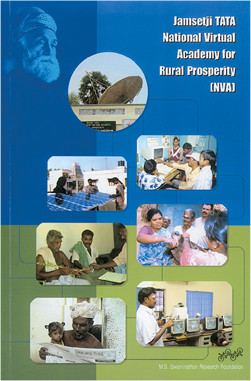
The precursor to this institute was the M. S. Swaminathan Research Foundation which has been functioning since 1989 to impart pro-nature, pro-poor and pro-women orientation to technology development and dissemination. On Tata’s death centenary on May 19, 2004 it was decided to form a National Alliance for Achieving Rural Knowledge Revolution to honor the legend "who showed that seemingly impossible tasks could be achieved through vision, determination and dedicated work,” as mentioned in a road map of the organization.
Mission 2007 has been finalized to take the benefits of ICT to every village in India by August 15, 2007 which marks the 60th anniversary of India’s independence. The Academy in association with alliance partners plans to identify a million grassroots knowledge workers who will be enlisted as Fellows of the Academy. They would serve as the torchbearers of the knowledge revolution in the 60,000 villages. Following the induction of the first set of 143 Fellows in New Delhi on July 11, 2005, the second batch of 155 Fellows for 14 states and union territories was inducted by the President of India Dr A. P. J. Abdul Kalam on January 5, 2006 in Hyderabad on the occasion of the 93rd Indian Science Congress. Village knowledge centers would be set up and managed by ICT self-help groups. The green revolution helped to improve the production of wheat, rice and other crops but a knowledge revolution can lead to the enhancement of human productivity and creativity in every area of human endeavor, mentions a profile of the Academy.
◆ ◆ ◆
From the archive