
Zoroastrians Abroad
A radiologist in Wales
When the Prince Charles Hospital in Merthyr Tydfil, Wales opened its second wing in July 2004, it invited its senior-most and longest serving consultant to welcome Charles, Prince of Wales, to formally cut the ribbon. And when Dr Reyaze Ginwalla retired later in the year, it hosted a big farewell party for him. But there is such a shortage of consultants in radiology, the Hospital has invited him back to work part-time, two days a week.
Reyaze and his wife Feroza (née Pocha) love to travel. So it was after a two-week cruise around the Mediterranean Sea, a month in Muscat with his sibling twins and in the course of a month in India, including a week in Goa, that Parsiana caught up with the duo for a leisurely chat and gleaned the information and opinions presented here. En route home to Wales, they were toying with the idea of stopping off for a while in Rome.
Because radiology is central to the investigation and further management of patients, Ginwalla says his years as clinical director of the radiology department (1994-2000) were particularly busy. The department underwent radical change with expansion and new equipment. Among other things he says he introduced video fluoroscopy, a technique for studying swallowing problems arising in patients due to conditions like strokes or laryngectomy (where the voice box is removed) and in children’s diseases like cerebral palsy. Unless the patient learns to swallow properly, he/she could be prone to chest infections like pneumonia which could even be fatal. Video fluoroscopy can check where the problem is, so that speech therapy or surgery can help the patient swallow properly.
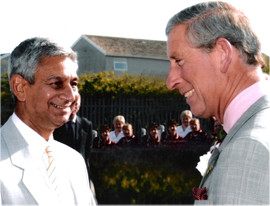
Ginwalla (L) with Prince Charles: discussing the NHS?
The colo-rectal cancer management team is one of the Hospital’s interdisciplinary organizations on which Ginwalla worked. The team meets two hours each week to decide on the management of patients suffering from cancer of the colon and rectum. In 1999 it was awarded a prize as the best multi-disciplinary team in the UK. Ginwalla tells us that they used the £ 5,000 prize money to purchase research equipment and payment of salaries for research registrars. In 2003, at a European seminar on colo-rectal disease in Barcelona, Ginwalla had presented a paper on how one needs to deal with co-morbidity factors like high blood pressure, heart trouble, lung disease, diabetes, etc on bowel preparation for patients undergoing barium enemas. The paper concentrated on the various factors which affect the preparation, the patient and the end result, and what one needs to do about it. "Big cancers we will see anyway,” Ginwalla tells us. "What we want to see is the small cancer, detect it before it spreads. Cancer and bowel waste look alike on the screen. Hence cleanliness of the bowel is paramount because medico-legal litigation is a fact of life.”
There are very few doctors in administration or in positions of power, so many decisions are made by non-medically qualified personnel, observes Ginwalla. There is tremendous stress at work because of the shortage of consultants, with long hours and days and nights on call. "Each patient bed which used to cost £250 a day costs £400 per day today.” That is the National Health Service (NHS) cost per patient, per day, he notes, adding that patients have to wait, sometimes up to 18 months, before they are called to receive the hospital treatment they need. "Some die before they are called,” he adds sadly.
Medicine is in Ginwalla’s blood. His father Mino had retired as professor of maxillo-facial surgery and dean of Bombay’s Nair Dental Hospital. His mother Tehmi, a professor of periodontology there, had succeeded her husband as dean. They passed away in 1986 and 1985 respectively.
An alumnus of the erstwhile Hill Grange High School and of Jai Hind College, he joined the Armed Forces Medical College (AFMC) in Poona which had just been inaugurated by defence minister Krishna Menon in 1962. According to its prospectus, the AFMC selected 120 students from the thousands who had applied. Sixty went into the army, the rest into civilian life. This first group, known as the A Batch, continues to have annual get-togethers in India, UK and the US, Ginwalla informs us.
After working at the B. D Petit Parsee General Hospital, the Breach Candy, Sion and Nair Hospitals, Ginwalla acquired his MS in surgery from the University of Bombay in 1971 and worked with the Family Planning Association in Bombay doing vasectomies before proceeding to the UK, ostensibly to acquire an FRCS degree but found after a year at London’s Hammersmith Hospital and another year in Lancashire that he didn’t "enjoy surgery.” More attracted to the "new and upcoming techniques” in radiology, Ginwalla joined the University of Wales’ College of Medicine and, thereafter, the Prince of Wales Hospital in 1980.
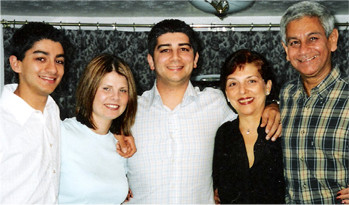
The Ginwallas (L to R): Cyrus, Anne Marie, Jimmy, Feroza and Reyaze
The fun-loving, concert-going couple — he’s an expert gardener, she’s such a good cook, the only snag about traveling, says Reyaze, is that all other culinary fare seems second rate — is blessed with two sons. Cyrus, a pharmaceuticals executive married to solicitor Anne Marie, lives in Wales. Jimmy, a part of the EasyJet Airlines’ cabin crew, lives in Gatwick. The couple had met in Bombay where Feroza was initially working as a hairdresser after her graduation. When she went on holiday to England and to meet him, they decided they didn’t want to part. A registered marriage was followed by a Zoroastrian ceremony at the old Zoroastrian House at Compayne Gardens performed by the venerable Dastur Sorab Kutar and Ervad Burjor Magol in 1973.
With their circle of Welsh and Indian friends the Ginwallas find life in Cardiff "lovely and very peaceful.” Nor is racial disharmony an issue. "When you live in an area mainly inhabited by professional people, people who are educated, there is little if any racial disharmony or tension as everybody accepts the other person for what he is rather than his color.” They enjoy meeting long standing Parsi friends in Cardiff and other parts of the UK. And when Parsi boys and girls come to the University of Cardiff for medical studies they are frequent and welcome guests at the Ginwalla table for some authentic home cooking.
The Ginwallas love our religion and have great faith in it. "We believe in God, we are guided by God. Both our boys had their navjote at Allbless Baug...Whenever we come to Bombay, the first thing we do is go to the agiary...”
◆ ◆ ◆
From the archive