
Events & Personalities
Pudumjee’s puppets
After spending a month in Spain curating a puppet exhibition from the archives of the Sangeet Natak Akademi, puppeteer Dadi Pudumjee returned to India just a day before the launch of the Ishara International Puppet Theatre Festival in Delhi from January 18 to 22, 2005. This Festival brings together groups from India, UK, Spain, Ireland and Indonesia with the shows ranging from traditional rod and string puppets to visual stories and epics, notes a press release.
After the inauguration at the India Habitat Centre, Dadi Pudumjee and Sudesh Choudhary with their puppets, dancers and objects presented Decote, a 20-minute "tribute to the spirit of movement and puppetry.” An aerial dance and acrobatic performance with masks and puppets, Decote took a flying leap into the workings of the mind, portraying conflict, balance, shapes and colors, both internal and external. With house full shows, the Festival has created an interest abroad "and each year we are flooded with requests for groups to perform at the event,” writes Pudumjee.
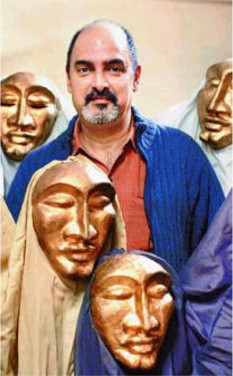
Pudumjee: providing platform for puppeteers
"The ‘father’ of the Ishara Puppet Festival that has managed to grab a permanent space here on the India Habitat Centre calendar, Pudumjee has managed to break the stereotype that puppets are for children,” writes Mandira Nayar who interviewed him. Moving from puppets on a string, and the hand and glove kind to rod puppets, Pudumjee might stick to some traditional form but his treatment of the subject as well as the story is completely new. With his puppets being larger than life in certain shows, his presentations deal with abstract subjects as in Images of Truth and illusions of love in Transposition. "I like to mix the real with the unreal and play with scale. In the last few years people have come into puppetry from different fields like fine arts and dance; and the work you do is influenced by that...Like any art form, puppetry must also adapt to the surroundings. It has to be refined or no one will see it,” Pudumjee conveyed to Nayar.
"Puppetry needs a lot of support. The government does lend some support, but it is not easy to make a living out of puppetry,” confessed the master puppeteer. "Traditional puppeteers supplement their income by selling craft on the side. Shows never bring in money.” Describing Pudumjee’s domain, Nayar wrote, "Opposite Delhi’s tallest landmark — the Qutab Minar — in a tiny lane is an obscure ‘studio’ hidden in the chaotic clutter of small shops and dirty dispensaries. A small room in which paper comes ‘alive.’”
During his early days in Poona, puppetry was a hobby. Later when he was studying at Ahmedabad’s National Institute of Design he got involved with Darpana that used to have programs with puppets. Fuelled by the Satellite Instructional Television Experiment where they used puppets for educational purposes, Pudumjee proceeded to Sweden to study puppetry. "He might have been the first Indian to perform at New York’s legendary La MaMa experimental theater off Broadway a few years ago, but in India he is fighting a losing battle,” writes Nayar. Although recognition may be easier abroad than on his home territory Pudumjee is determined to continue with the tradition.
◆ ◆ ◆
From the archive