
Events & Personalities
Musical legacy
The first live symphony he heard was the Vienna Philharmonic Orchestra when he was 18 years of age and by the time Zubin Mehta was 25, the legend had already conducted the Philharmonics in Vienna and Berlin. It was an easy rapport and respect that 67-year-old Mehta shared with the 90-member Vienna Philharmonic Orchestra which performed under his baton at Bombay’s Jamshed Bhabha Theatre on March 28 and 29, 2003. This is the Vienna Orchestra’s second tour to Bombay in the last 50 years but for the conductor "it is coming back home full circle,” reported the Afternoon Despatch and Courier of March 28. Performing his first concert in India after the demise of his father Mehli, on October 19, 2002 at the age of 94, Zubin told the Mumbai Newsline of March 28, "I feel all the more now, the need to carry his legacy forward.”
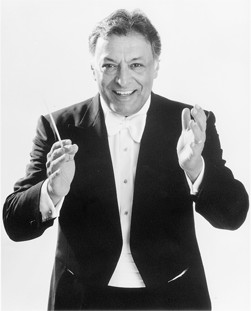
Z. Mehta: evolving as a conductor
For the shows presented by the Mehli Mehta Music Foundation, sponsored by the Taj Hotel in Bombay, Rabo India and Sahara India, and supported by the Austrian Embassy, the Orchestra members reportedly waived their professional fees and television royalties and even conducted a free concert for children at the Tata Experimental Theatre, believing it’s important to connect with them and let them have a feel of the instruments, noted the Mumbai Newsline. For the evening shows the Orchestra performed the works of Beethoven, Schubert, Haydn, Mahler and Otto Nicholai, the founder of the Vienna Orchestra. For the juniors Zubin led 20 Orchestra members through Strauss’ Voices of Spring, encouraging the kids to keep time, hum and even conduct. As the children identified each instrument, the musicians explained its distinguishing features, complete with little demonstrations, reported The Indian Express of March 31.
Currently music director of the Bavarian State Opera, music advisor and chief conductor of the Maggio Musicale Fiorentino, the summer festival in Florence, Italy and music director for life of the Israel Philharmonic, Zubin divides his time between Israel and Florence. How does the conductor make an orchestral work, played countless times, sound fresh each time? As he explained to The Times of India of March 26, "Each time you come to a work after a gap of time you find details you hadn’t noticed before... There’s also your own growth and evolution....That’s because my outlook on life has changed. You also learn from the orchestra. Each musician will have his own emphasis in the way he plays his solos...If I don’t agree with his interpretation I will tell him but I may also see something new.”
◆ ◆ ◆
From the archive